






Skip to content
FHI 360
  • Languages
  • Low bandwidth
  • High bandwidth
  • Search
  • Who we are
        • Who we are
          • About us
          • Leadership
          • Ethics and safeguarding
          • Impact and financial reports
          • Contact us
        • About us

          Impact and financial reports

  • What we do
        • What we do
          • Economic opportunity
          • Health


        • How we do it
          • Research in action
          • Humanitarian response
          • Digital innovation and AI
        • Explore our expertise
        • Economic opportunity

          Health

  • Where we work
        • Where we work
          • Asia Pacific
          • Central Africa
          • East Africa
          • West Africa
          • Southern Africa
          • Middle East and North Africa
          • Europe and Central Asia
          • Latin America and the Caribbean
          • United States
        • Around the world

          In the United States

  • Work with us
        • Work with us
          • Join our team
          • Local partners
          • Government and multilateral funders
          • Foundations and corporations
          • Academic and research partners
          • Small businesses and vendors
        • Join our team

          Local partners

          Government and multilateral funders

          Foundations and corporations

          Academic and research partners

          Small businesses and vendors

  • News & events
        • News
          • Newsroom
          • Events
        • Get the latest news
        • Newsroom

          Events

  • Stories & blogs
        • Stories & blogs
          • Stories
          • Videos (YouTube)
          • Blog
        • Explore our storytelling
        • Our storytelling

          Blog

  • Resources
        • Resources
          • Resource library
        • Resource library

Home | Expertise | SCALE+ methodology | Advance collective action

SCALE+ methodology

Advance collective action

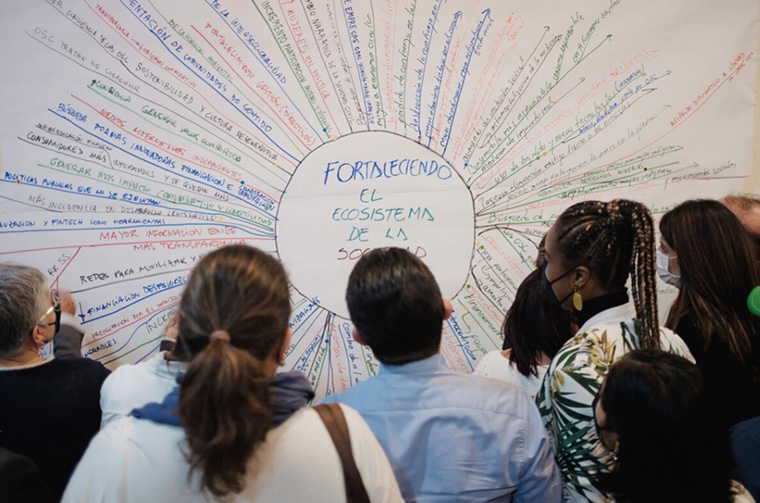
During the whole-system-in-the-room (WSR) retreat, participants identify the most pressing issues they face, their common goals and the major barriers to overcome. To advance collective action to overcome barriers and in service of shared goals, SCALE+ helps projects lead stakeholders to coordinate and collaborate, apply social-change methodologies, provide demand-driven technical assistance, and improve information flow. 

SCALE+ helps groups like Consejo Comunitario Mayor de la Asociación Campesina Integral del Atrato (COCOMACIA), which preserves traditions, identity and heritage in Quibdó, Colombia, collaborate with diverse partners. From top, clockwise: Yessica Monroy, María del Socorro Mosquera, Ana Rosa Heredia, Julia Susana Mena and Rubiela Cuesta, of COCOMACIA. Photo credit: Juan Sebastián Molina/FHI 360

Coordinate and collaborate  

The Systems Integration (SI) Team supports stakeholders in collaborative action circles and task forces to move forward with agreed-upon activities by creating space for continued dialogue, organizing topical meetings, and continuously reminding the participants of their commitments to action while encouraging new actions and inviting new players. In view of stakeholder commitments and in consultation with the Cross-Sector Advisory Committee (CSAC), the project considers the best use of its resources to provide technical assistance where most needed to stimulate further collaboration, address gaps in collective capacity, and achieve results. 

Apply social change methodologies 

SCALE+ offers a project team the opportunity to apply a combination of social-change methodologies and behavior-change tools, including advocacy, public policy reform, social- marketing campaigns, conflict mediation, awareness-raising through mass media, education, and organizational capacity strengthening. Specific intervention options are discussed by project leadership and the SI Team in consultation with the CSAC and funder to decide the most effective and essential interventions.  

Provide demand-driven technical assistance 

SCALE+ identifies resources, energy and support previously undiscovered among the system’s actors. Once agreed upon with the funder, specific examples of targeted, demand-driven technical assistance can be integrated into the overall project work plan. Ideally, project work plans should: (1) support the collective goals and priorities of the cross-sector stakeholders and the stakeholder commitments to collective action; (2) strengthen horizontal communication, relationships and networks; and (3) leverage funder financing and private-sector investments to achieve results. 

Improve information flow 

With SCALE+, technical interventions are designed according to common objectives and where stakeholders are willing to collaborate most. The project applies its own limited resources to achieve its goals by aligning them, when possible, to the collective goals of cross-sector stakeholders. By continuously improving the flow of information among stakeholders and coalition partners, the project will be able to keep everyone focused on collaborating to achieve their common purpose.  

Documents / Downloads
Applying the SCALE+ method: Advance collective action
Share expertise
Back to top

SCALE+ methodology navigation

  • SCALE+ methodology
  • Invest in collaboration
  • Map the local ecosystem
  • Formulate a common agenda
  • Advance collective action
  • Measure results

On this page

FHI 360

We are a nonprofit organization that mobilizes research, resources and relationships so that people everywhere can access the opportunities they need to lead full, healthy lives.

  • Partner with us
  • Business opportunities
  • Contract mechanisms
  • Small business
  • Our FHI 360 network
  • Events
  • Employee access
  • Contact us
  • Press
  • Privacy notice
  • Ethics and safeguarding

FHI 360 Headquarters
359 Blackwell Street, Suite 200
Durham, NC 27701 USA
1.919.544.7040

Washington, D.C., Office
2101 L Street NW, Suite 700
Washington, DC 20037 USA
1.202.884.8000

Anti-trafficking statement

Connect

Sign up for our mailing list and receive the latest updates from FHI 360 straight to your inbox!

  • LinkedIn
  • Facebook
  • X
  • Youtube
  • Instagram

FHI 360 is the registered trade name of Family Health International.

  • Terms of use
  • Cookie notice
©2026 FHI 360
GDPR Cookie Banner

We are using cookies to give you the best experience on our website.

You can find out more about which cookies we are using or switch them off in .