

Maiduguri, the capital of Borno State in northeast Nigeria, welcomes visitors with a sign featuring a quote from Nobel Prize laureate Malala Yousafzai, “With education, you can kill terrorism.”
The humanitarian crisis in Borno is acute. Ten years of conflict from armed opposition groups have exacerbated development challenges, including limiting access to education for many children and youth. Students and teachers have been victims of violence throughout the crisis, and the numbers continue to increase.
 But FHI 360’s Addressing Education in Northeast Nigeria (AENN) activity, funded by the U.S. Agency for International Development, is helping to strengthen the education system and provide equitable access to education for more than 300,000 children in the region. AENN works with state government agencies to review, streamline and simplify instructional materials on basic literacy, numeracy and social emotional learning (SEL), which helps teachers, students and their parents and caregivers feel safe and supported.
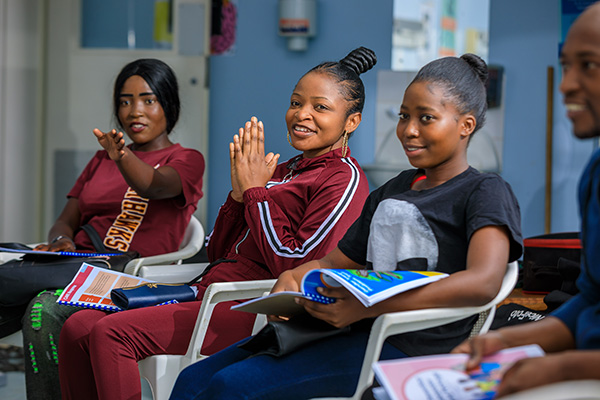
Halima Abdulgani teaches at Bulabulin Primary School in Maiduguri. In the morning and early afternoon, Bulabulin operates as a formal school with a regular curriculum. In the late afternoon, however, it becomes a nonformal learning center that welcomes 600 out-of-school boys and girls ages 6 to 15. Centers like this one teach an accelerated curriculum, aiming to get these children caught up and matriculated into formal schools in just nine months. Many of the children are internally displaced, having fled their homes to find safety after experiencing violence, trauma or the loss of parents or other loved ones.
“Students first come to class feeling depressed. I try to draw them close to me and provide solutions,” Ms. Abdulgani said. She believes SEL, the process through which children and adults learn how to understand and manage their emotions, is a critical part of the curriculum, a powerful tool that helps children to cope with adversity and trauma.
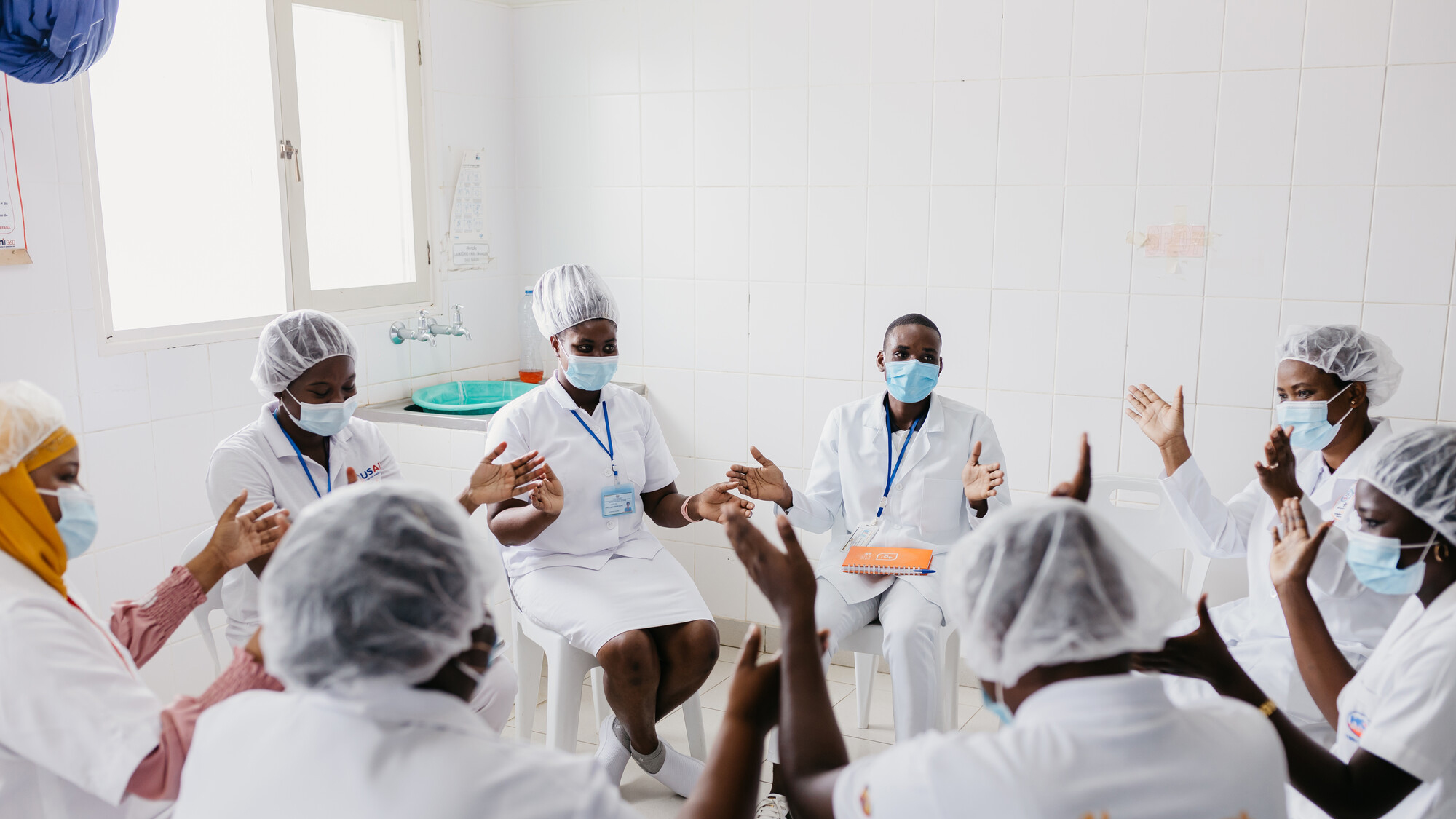
“The kids get to come outside for SEL classes. They play games and are excited. That is when kids feel best,” she explained. Games and mindfulness activities help the children relate to and connect with each other as well as relax and have fun.
Amina Mohammed, 12, is one of Ms. Abdulgani’s students. She is from Ngala, a large village northeast of Maiduguri. She fled her home with her mother and seven siblings; her father was killed before they reached safety. Amina finds joy in school. She loves reading “Ah Bah Cha Dah,” or ABC’s in Hausa, her native language, with AENN-developed literacy materials.
AENN has trained 600 learning facilitators and more than 900 teachers in 42 formal schools in the use of these materials and how to provide quality instructions to their learners. The AENN team also works with school personnel and community leaders to develop safety plans and early warning systems to protect schools and those inside them from harm.
In Damaturu, in the nearby state of Yobe, many internally displaced persons have been integrated into their host communities. The task of integration often falls to village leaders like Mr. Lawan Sumsumma, who has been head of the village of Sumsumma on the outskirts of Damaturu for more than 20 years. Mr. Sumsumma was familiar with addressing traditional problems, such as family disagreements or marital issues. But now, his responsibilities have changed as his community welcomes more displaced persons.
AENN provides community action cycle training for Mr. Sumsumma and other leaders so that they can set priorities, plan and act collectively for their own well-being. The training helps him and his community manage and address these new challenges.
AENN works in 75 nonformal learning centers and 42 formal schools in the Damaturu region, providing 3,700 out-of-school children with access to a quality education and offering instructional materials to more than 300 teachers. Part of Mr. Sumsumma’s job is to mobilize the community and make them aware that these centers and schools exist. His team goes door-to-door, talking to parents or caregivers and encouraging them to send kids to school.
“I visit schools and see progress – the children learn a lot,” he said. “The most important thing we need here is education. Education is the basis and background for every human being.”
Back in Maiduguri, Ms. Abdulgani agrees. She shares a special bond with her students. “When they see me in the market, they run to me. This makes me feel like they will be good citizens. I have hope.”
Photo credits: Anna Eisenberg/FHI 360