



Skip to content
FHI 360
  • Languages
  • Low bandwidth
  • High bandwidth
  • Search
  • Who we are
        • Who we are
          • About us
          • Leadership
          • Ethics and safeguarding
          • Impact and financial reports
          • Contact us
        • About us

          Impact and financial reports

  • What we do
        • What we do
          • Economic opportunity
          • Health


        • How we do it
          • Research in action
          • Humanitarian response
          • Digital innovation and AI
        • Explore our expertise
        • Economic opportunity

          Health

  • Where we work
        • Where we work
          • Asia Pacific
          • Central Africa
          • East Africa
          • West Africa
          • Southern Africa
          • Middle East and North Africa
          • Europe and Central Asia
          • Latin America and the Caribbean
          • United States
        • Around the world

          In the United States

  • Work with us
        • Work with us
          • Join our team
          • Local partners
          • Government and multilateral funders
          • Foundations and corporations
          • Academic and research partners
          • Small businesses and vendors
          • CEO position specification
        • Join our team

          Local partners

          Government and multilateral funders

          Foundations and corporations

          Academic and research partners

          Small businesses and vendors

  • News
        • News
          • Newsroom
        • Get the latest news
        • Newsroom

  • Stories
        • Stories & blog
          • Stories
          • Videos (YouTube)
          • Blog
        • Explore our storytelling
        • Our storytelling

          Blog

  • Resources
        • Resources
          • Resource library
        • Resource library

Home | Articles | Creating a guide for boosting vaccine uptake
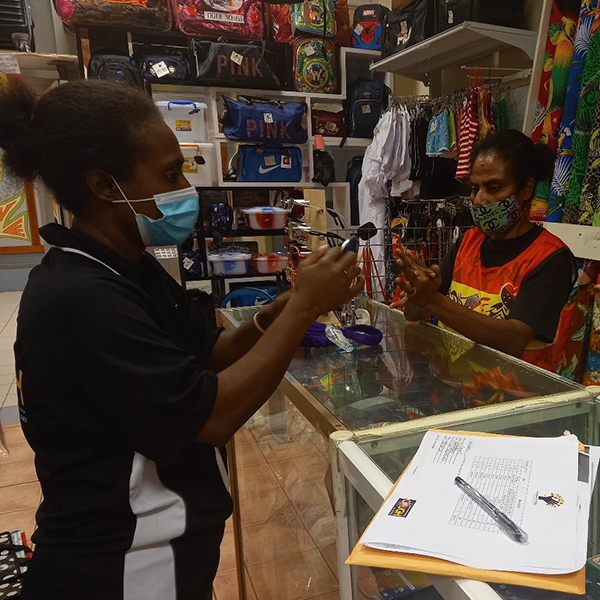
Photo caption: Teresa Koratsi, registered health extension officer at Businesses for Health Papua New Guinea (B4H), demonstrates to shop floor workers how to properly wash hands with hand sanitizer at a downtown plaza in Port Moresby.
March 28, 2022

Creating a guide for boosting vaccine uptake

Since December 2020, the most significant appeal in the efforts to end the COVID-19 pandemic has been a simple one: Get vaccinated.

But it actually isn’t so simple. The push to vaccinate the world has exposed major issues of inequity — and the vaccination gaps between high- and low-income countries are striking. Ensuring equitable access is essential, but access alone is not always enough.

In many cases, the vaccine is available, but people are hesitant to stick out their arms. In Papua New Guinea, vaccine resistance has been a major hurdle: This Asia Pacific nation has one of the lowest COVID-19 vaccination rates in the world — fewer than 3 percent of the population are fully vaccinated. To combat misinformation and increase the demand and uptake for vaccination services, FHI 360 created and field-tested the Demand Creation and Advocacy for COVID-19 Vaccine Acceptance and Uptake Toolkit. Funded by FHI 360’s Social and Behavior Change Division and the Market Development and Product Introduction initiative, this toolkit is a practical guide and technical assistance package that supports local organizations in designing, implementing and adjusting COVID-19 interventions.

“One big gap we saw with existing social and behavior change products and guides was that there was a lot of information on what needs to be done, but not really tailored guidance on how to do it,” says Emily Bockh, a technical advisor at FHI 360.

As part of the toolkit, the Quick Start Guide focuses on the “how” by offering practical tools and guidance that organizations can customize for their individual circumstances. “Global Boosters” build on existing evidence to jumpstart local efforts to tailor techniques and messages for specific audiences. In addition, the guide provides information on factors that influence vaccine uptake as well as a list of global databases where partners can find critical local research and data.

In Papua New Guinea, FHI 360 trained local organization Businesses for Health Papua New Guinea (B4H) to use the Quick Start Guide to help reduce COVID-19 transmission and increase demand for vaccines among small-business owners and employees in the bustling industrial hubs in and around the National Capital District of Port Moresby.

“Instead of trying to give information to everyone on what COVID-19 is, how to prevent it, and what the Department of Health is doing — and requires everyone to do — to reduce the impact of the pandemic, the social and behavior change training taught us to deliver messaging specific to the type of audience that we meet,” says Teresa Koratsi, workplace case coordinator and registered health extension officer at B4H.

B4H was established in 2017 in response to the challenges of tuberculosis and HIV in Papua New Guinea. It now offers workplace trainings on infection prevention and COVID-19 control in support of the national COVID-19 prevention and treatment campaign known as the Niupela Pasin (the “new normal”).

In downtown plazas and megamalls, over the course of three months, Koratsi and her team visited 207 small shops, mostly women-operated, to give presentations and share information on COVID-19 prevention and vaccination.

An evaluation of their visits reveals that the face-to-face approach is much more effective than any other way of promoting changes in health behaviors and vaccine uptake. After attending the presentations, participants knew where to go for a COVID-19 test and where to look online for the latest COVID-19 information. They could also identify the country’s largest infectious disease killer (tuberculosis) and the greatest risk factors for COVID-19. Most surprisingly, in contrast to other recent studies in the country, only a minority of participants reported that they would not get vaccinated: 20 percent of participants said they intended to get vaccinated and about one-third were thinking about it as a result of participating in the workplace sessions (27 percent of participants had already been vaccinated).

“The employees’ request across all the shops we visited has been the same: ‘Bring this awareness to our families back in the communities,’” Koratsi says.

Now, the team at B4H has the tools they need to raise awareness of — and increase advocacy for — COVID-19 vaccination. And they can use the process, tools and approach in the Quick Start Guide to build acceptance of new technologies in other areas of health.


Photo credit: Businesses for Health Papua New Guinea

Share article
Back to top

Related articles

News
New AI chatbot aims to boost teacher pedagogical support
May 11, 2026
News
Why more employers are turning to apprenticeships — and seeing results
April 24, 2026
News
Investing in hope: How Nigerian women are building economic opportunities
April 16, 2026

On this page

FHI 360

We are a nonprofit organization that mobilizes research, resources and relationships so that people everywhere can access the opportunities they need to lead full, healthy lives.

  • Partner with us
  • Business opportunities
  • Contract mechanisms
  • Small business
  • Our FHI 360 network
  • Events
  • Employee access
  • Contact us
  • Press
  • Privacy notice
  • Ethics and safeguarding

FHI 360 Headquarters
359 Blackwell Street, Suite 200
Durham, NC 27701 USA
1.919.544.7040

Washington, D.C., Office
2101 L St NW, Suite 700
Washington, DC 20037 USA
1.202.884.8000

Anti-trafficking statement

Connect

Sign up for our mailing list and receive the latest updates from FHI 360 straight to your inbox!

  • LinkedIn
  • Facebook
  • X
  • Youtube
  • Instagram

FHI 360 is the registered trade name of Family Health International.

©2026 FHI 360

We are using cookies to give you the best experience on our website.

You can find out more about which cookies we are using or switch them off in .

FHI 360
Powered by  GDPR Cookie Compliance
Privacy overview

This website uses cookies so that we can provide you with the best user experience possible. Cookie information is stored in your browser and performs functions such as recognising you when you return to our website and helping our team to understand which sections of the website you find most interesting and useful.

Essential cookies

Essential cookies should be enabled at all times so that we can save your preferences for cookie settings. However, they can be enabled or disabled using the button below.

Non-essential cookies

This website uses Google Analytics to collect anonymous information such as the number of visitors to the site, and the most popular pages.

Keeping this cookie enabled helps us to improve our website.