

Resources
Search
Filters
-
Fact sheet
Empowering Women and Girls (fact sheet)
July 2012 — FHI 360 programs work to eliminate gender disparities and promote gender equality. As women and girls bear a disproportionate share of the world’s poverty and have less access to resources than men, we promote the rights of girls and women to high-quality education and health care and to full participation in social, economic […]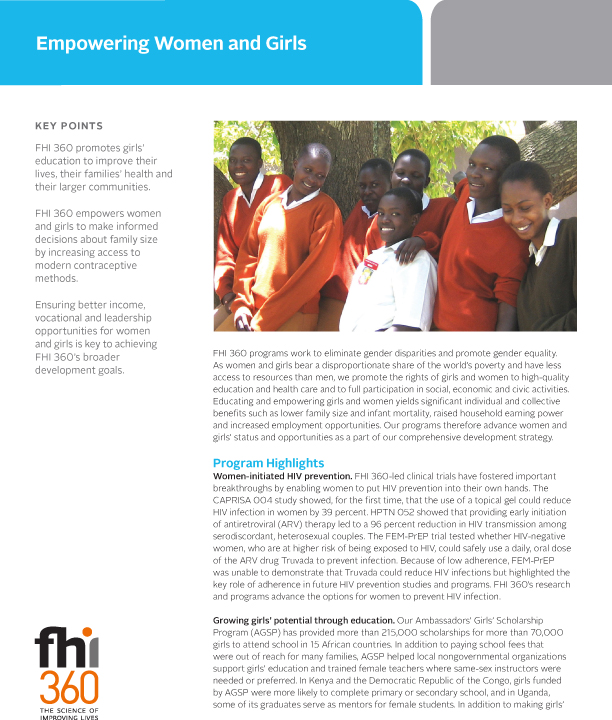
-
Fact sheet
Effective Training Practices (fact sheet)
February 2012 — Training is an effective tool for improving performance, but it must be conducted with careful attention to the needs of learners, the context in which learners perform and current evidence about what makes training effective. This brief summarizes evidence and best practices for making the most of training interventions. It is designed to […]
-
Fact sheet
Facilitating Quality Science at the Country Level: CAPRISA 004 (fact sheet)
July 2012 — The results of the CAPRISA 004 study invigorated the world of HIV prevention. A promising step toward giving women a new tool to protect themselves, this was the first time that a microbicide trial showed a statistically significant decrease in HIV acquisition, with an estimated 39 percent reduction in risk. Encouragingly, it also […]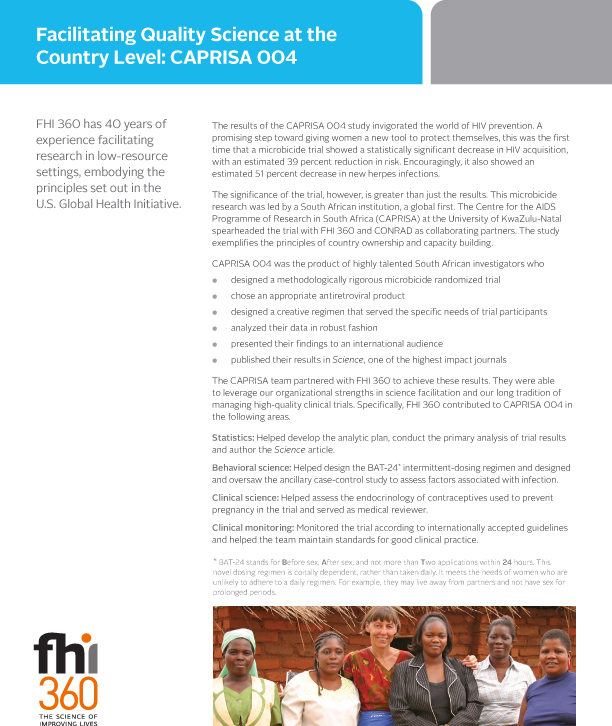
-
Guide, manual or tool
How Much Will It Cost to Scale Up a Reproductive Health Pilot Project?
November 2007 — This brief explains how to adapt and modify cost information obtained from a pilot project to estimate scale-up costs. The brief shows why the costs of a pilot project alone are not sufficient to predict costs of scale-up, and gives examples of how costs are influenced by factors like economies and diseconomies of […]
-
Fact sheet
Make Better Use of Provider Time in Public Health Clinics
August 2006 — This program brief — produced by The Frontiers in Reproductive Health Program — explores the time use of health care providers in public health clinics in the context of diminishing funding for reproductive health services.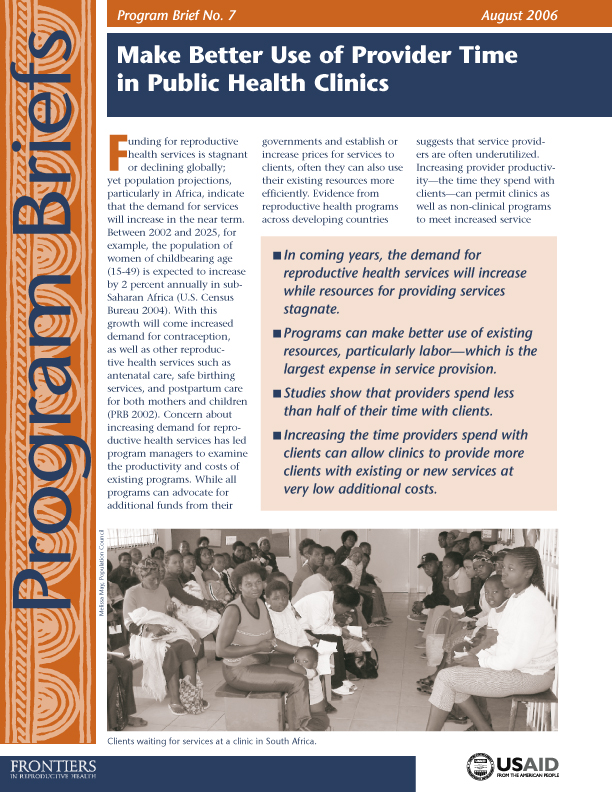
-
Fact sheet
Male Circumcision for HIV Prevention: Lessons From Kenya’s Experience
2009 — This article explores the lessons learned during the first year of an initiative by the Government of Kenya to improve access to voluntary medical male circumcision for HIV prevention. The Male Circumcision Consortium, led by FHI 360, provided support to the Government of Kenya. The article was published in Exchange, a magazine about HIV […]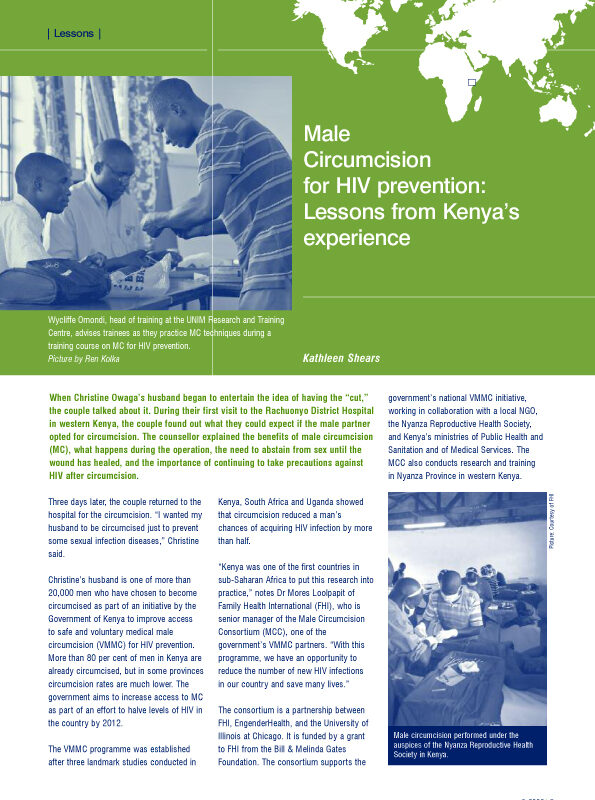
-
Research paper or report
Building a Palliative Care Program in Ethiopia: The Impact on HIV and AIDS Patients and Their Families
July 2010 – Home – and community-based care in Ethiopia implements palliative care through the continuum of care in 14 major cities with links to local health facilities. Community support through traditional burial societies (idirs) makes it possible for the program to provide holistic care to people living with HIV (PLHIV) and their family members. The […]
-
Research paper or report
From Burial Societies to Mutual Aid Organizations: The Role of Idirs — Traditional Burial Societies in Ethiopia — In Ensuring Community-Level Care and Protection of Vulnerable Children
March 2012 – From 2004 through 2009, Family Health International engaged 270 Idirs—traditional burial societies—in Ethiopia’s fight against HIV and AIDS, which required the Idirs to change from only supporting death and mourning ceremonies to also supporting the living via mutual aid. Results show that more than 126,000 children received services and that these Idirs […]
-
Other
Relever les Défis: Capacity-building of the Reproductive Health Division in Senegal
March 13, 2012 — This presentation was given during an end-of-project meeting conducted by the PROGRESS project. PROGRESS (Program Research for Strengthening Services) is a five-year project awarded to FHI 360 by the U.S. Agency for International Development (USAID) in June 2008. The project seeks to improve access to family planning among underserved populations by providing […]
-
Other
Examining the Feasibility of Postpartum IUD Services in Rwanda: Study Findings
July 19, 2012 — This presentation was given during an end-of-project meeting conducted by the PROGRESS project. PROGRESS (Program Research for Strengthening Services) is a five-year project awarded to FHI 360 by the U.S. Agency for International Development (USAID) in June 2008. The project seeks to improve access to family planning among underserved populations by providing global […]
Join our team
FHI 360 is an inclusive and innovative community of experts in more than 60 countries around the world, united by a shared goal: to open opportunities for people everywhere so they can lead full and healthy lives. Join us today.
Become a partner
We are committed to building equitable, collaborative relationships with governments, local communities, academic institutions, foundations and others working to open pathways to lasting change.