




Resources
Search
Filters
-
Guide, manual or tool
A Guide for Conducting Behavioral Surveillance Surveys on HIV/AIDS
2007 — This publication is an Arabic adaptation of Behavioral Surveillance Surveys: Guidelines for Repeated Behavioral Surveys in Populations at Risk of HIV, which supports HIV prevention and behavior change efforts in the Middle East and North Africa. First published in 2000, this document is used by public health officials who run national surveillance and monitoring and evaluation systems.
-
Guide, manual or tool
A Guide to Nursing Care of People Living with HIV/AIDS (PDF in Arabic)
2007 — This guide aims to build the knowledge and capacity of nurses who work with people living with HIV or AIDS and to reduce stigma and discrimination toward them from health care workers. The guide’s topics include prevention, care and support; nursing practices; and treatment and control of opportunistic infections.
-
Fact sheet
IMPACT Project Documents
2002-2007 – These publications provide evaluations and results stemming from FHI 360’s Implementing AIDS Prevention and Care (IMPACT) project in Egypt and the Middle East and North Africa region. Funded by the U.S. Agency for International Development, IMPACT helped develop a national response to HIV/AIDS, strengthening the capacity of the Government of Egypt and civil […]
-
Guide, manual or tool
Meeting Adolescent Reproductive Health Needs
2007–2009 – With funding from the United Nations Population Fund, FHI 360 developed training manuals for peer educators and care providers at youth-friendly clinics to improve health care services, generate knowledge about reproductive health among youth and build capacity for long-term improvement of youth health services.
-
Guide, manual or tool
Guidelines for Conducting HIV Support Groups (Arabic, English)
2012 — This publication provides guidance on how to conduct HIV support groups that deliver psychological, emotional and educational assistance to people living with HIV or AIDS, their caregivers and their families.
-
Fact sheet
What You Should Know About Viral Hepatitis (PDF in Arabic)
2013 — FHI 360 developed this booklet to increase awareness of viral hepatitis among most-at-risk populations. Produced with funding from the Drosos Foundation, the booklet explains the types of hepatitis and proper management of the disease.
-
Fact sheet
ARV-Based HIV Prevention: State of the Science and Considerations for Implementation
December 2012 — This brief summarizes the take-home messages from a consultation to consider the potential introduction of microbicides and pre-exposure prophylaxis (PrEP) for HIV prevention in Kenya. The consultation was convened by the National AIDS/STI Control Programme and the Kenya Medical Research Institute, in conjunction with FHI 360, in Naivasha, Kenya, 25-26 on November 25–26, […]
-
Fact sheet
A Webinar on Safer Conception and Pregnancy Options for Women and Couples with HIV in Resource-Constrained Settings
Please join us on Tuesday, February 26, 2013 for a discussion about pregnancy options for women and couples with HIV. For HIV-positive or sero-discordant couples who want to conceive, the counseling and services they receive need to be tailored to their specific needs, which may vary from couple to couple. Some of the more technologically sophisticated […]
-
Fact sheet
Navigating College Readiness Through Asset Mapping (fact sheet)
October 2012 — Getting students on the path to enroll and succeed in postsecondary education requires an array of supports — from rigorous academic preparation, to the development of self-monitoring skills, to managing the college application and financial aid process. For many students and families, particularly those who are low-income or first-generation college students, these supports […]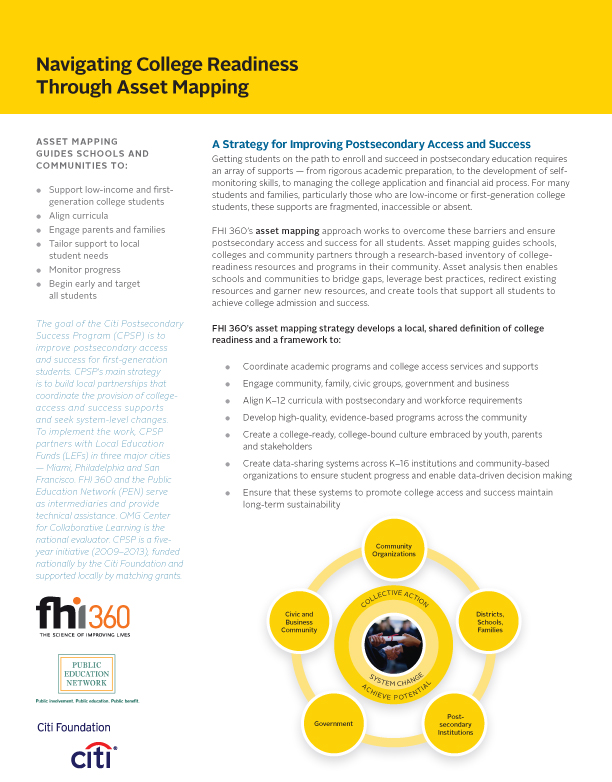
-
Fact sheet
Safer Infant Feeding for Prevention of Mother-to-Child Transmission of HIV
September 2011 — In many contexts, exclusive breastfeeding combined with antiretroviral treatment ensures the best chance of HIV-free survival of infants exposed to HIV. Counseling, peer support, education and community awareness can increase uptake of exclusive breastfeeding.
Join our team
FHI 360 is an inclusive and innovative community of experts in more than 60 countries around the world, united by a shared goal: to open opportunities for people everywhere so they can lead full and healthy lives. Join us today.
Become a partner
We are committed to building equitable, collaborative relationships with governments, local communities, academic institutions, foundations and others working to open pathways to lasting change.