




Skip to content
FHI 360
  • Languages
  • Low bandwidth
  • High bandwidth
  • Search
  • Who we are
        • Who we are
          • About us
          • Leadership
          • Ethics and safeguarding
          • Impact and financial reports
          • Contact us
        • About us

          Impact and financial reports

  • What we do
        • What we do
          • Economic opportunity
          • Health


        • How we do it
          • Research in action
          • Humanitarian response
          • Digital innovation and AI
        • Explore our expertise
        • Economic opportunity

          Health

  • Where we work
        • Where we work
          • Asia Pacific
          • Central Africa
          • East Africa
          • West Africa
          • Southern Africa
          • Middle East and North Africa
          • Europe and Central Asia
          • Latin America and the Caribbean
          • United States
        • Around the world

          In the United States

  • Work with us
        • Work with us
          • Join our team
          • Local partners
          • Government and multilateral funders
          • Foundations and corporations
          • Academic and research partners
          • Small businesses and vendors
          • CEO position specification
        • Join our team

          Local partners

          Government and multilateral funders

          Foundations and corporations

          Academic and research partners

          Small businesses and vendors

  • News
        • News
          • Newsroom
        • Get the latest news
        • Newsroom

  • Stories
        • Stories & blog
          • Stories
          • Videos (YouTube)
          • Blog
        • Explore our storytelling
        • Our storytelling

          Blog

  • Resources
        • Resources
          • Resource library
        • Resource library

Home | Articles | Sparking STEM2D at home during the COVID-19 pandemic
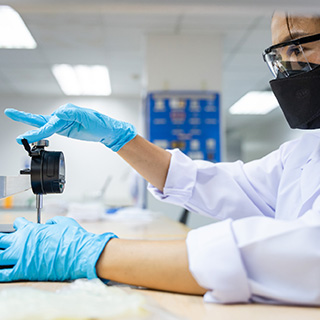
Female scientist looking at slides through microscope. Photo credit: Jessica Scranton/FHI 360
June 10, 2020

Sparking STEM2D at home during the COVID-19 pandemic

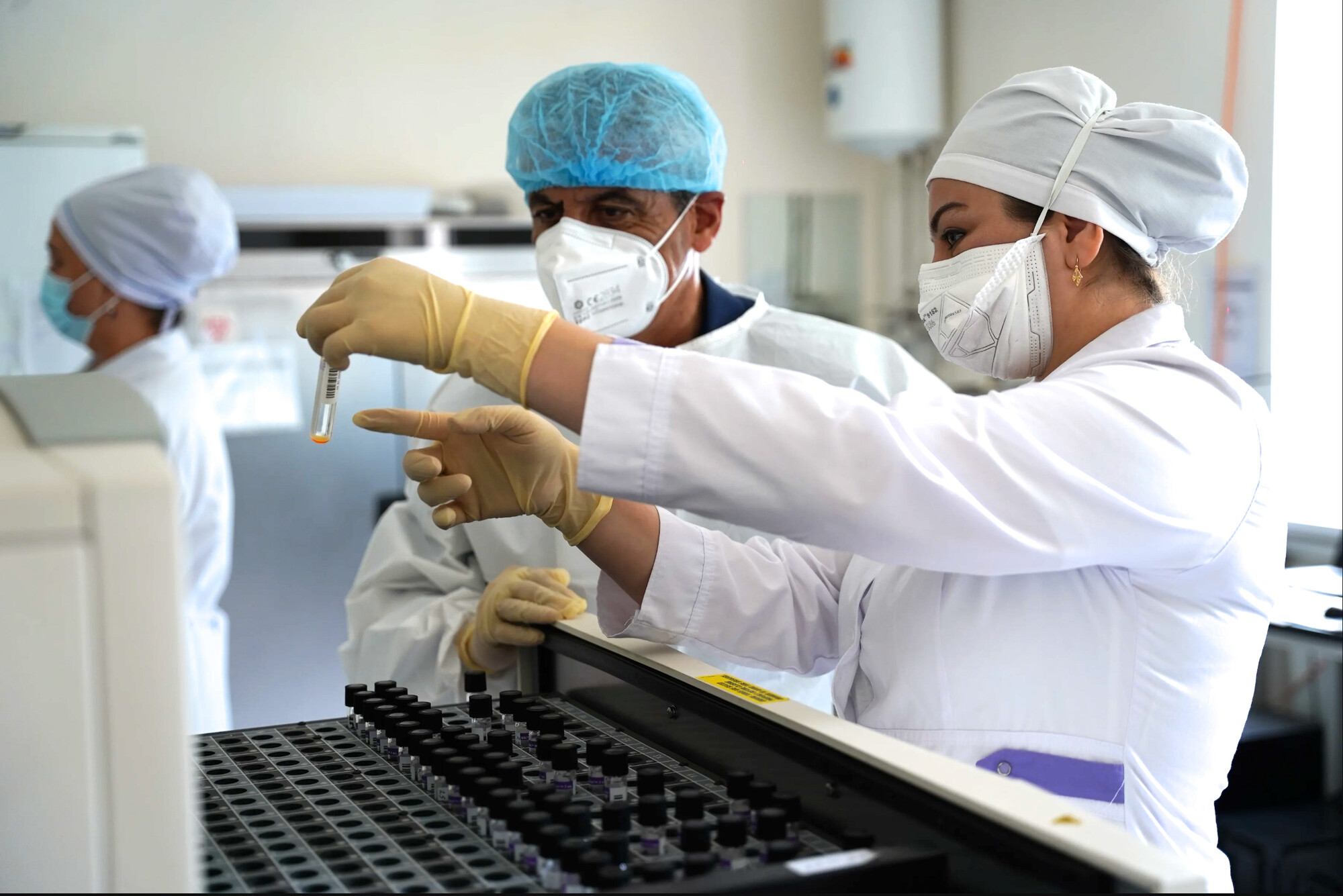
The COVID-19 pandemic has placed concentrated attention on health care workers, the importance of scientific discovery and the scientists working to find a cure. Without continuous scientific research, promising drugs and timely therapies might not be developed, and the world could be unprepared for the next global health challenge.

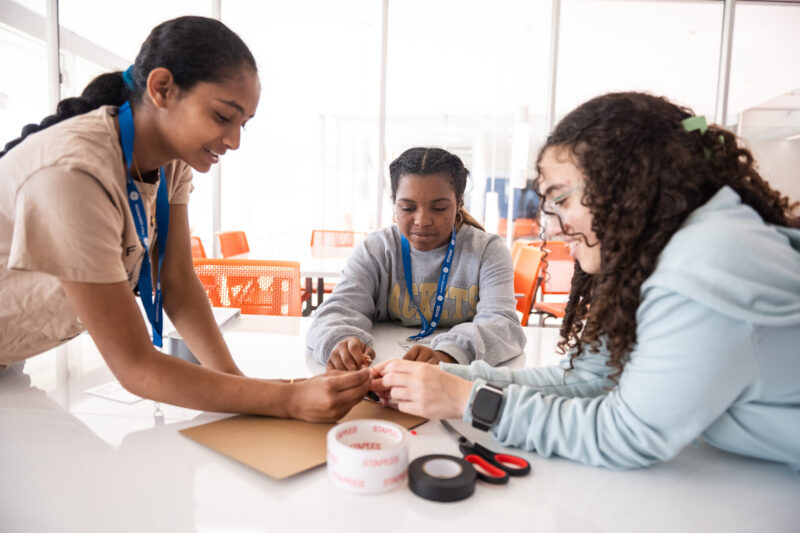
Through the Women in STEM²D (WiSTEM²D) project, FHI 360, Johnson & Johnson, Junior Achievement Worldwide, Girl Scouts of the USA and the Smithsonian Science Education Center are working to increase the representation of women and girls as researchers and medical practitioners in the science, technology, engineering, mathematics, manufacturing and design (STEM²D) workforce. Around the world, the program cultivates young women’s and girls’ interest in STEM²D education and careers through interactive sessions led by Johnson & Johnson volunteers. The sessions are designed for girls to build knowledge and critical skills. FHI 360 and Junior Achievement Worldwide developed a teaching guide that includes pedagogical strategies, activities and training for the volunteers.

Because of the COVID-19 pandemic, the WiSTEM²D project has been unable to conduct activities in person, so the partners are providing activities online for audiences at home. FHI 360 helped create and redesign activities to pivot from in-person experiments to interactive videos, e-books, student and parent activity tip sheets and more. Additionally, the partners hosted a four-part series of videos to discuss learning from home and careers in STEM²D.

Below are some of the activities that have been adapted for home learning:

  • Sugar Simulation: Learn what happens to particles when sugar dissolves in water and water evaporates.
  • Elephant Toothpaste: Introduce students to chemistry by demonstrating chemical reactions resulting in a large quantity of foam.
  • Think Like an Engineer: Find out how engineers solve problems with the Design Thinking Process. Engineer a life vest for a corgi.
  • Glider Guide: Soar above five terrains in the United States while learning about different types of land and water features.
  • Trait Tracker: Use computational thinking and system models to obtain data and uncover patterns on animals’ characteristics that can influence success in an environment.
  • Up with Gas: Examine how a chemical reaction inflates a balloon.

The COVID-19 pandemic has rapidly changed the nature of work and employment. Employers indicate that skills such as resilience, self-direction, critical and creative thinking, logical reasoning and problem solving will be necessary for young people to successfully transition into the post-pandemic workplace.

By enabling young women and girls to continue building STEM²D skills and confidence during the pandemic, FHI 360 and its partners are encouraging them to pursue these careers and are helping to prepare them for employment success in a changing economy.

Watch the four-part series, STEM2D Live @ Home.

Share article
Back to top

Related articles

News
New AI chatbot aims to boost teacher pedagogical support
May 11, 2026
News
Why more employers are turning to apprenticeships — and seeing results
April 24, 2026
News
Investing in hope: How Nigerian women are building economic opportunities
April 16, 2026

On this page

FHI 360

We are a nonprofit organization that mobilizes research, resources and relationships so that people everywhere can access the opportunities they need to lead full, healthy lives.

  • Partner with us
  • Business opportunities
  • Contract mechanisms
  • Small business
  • Our FHI 360 network
  • Events
  • Employee access
  • Contact us
  • Press
  • Privacy notice
  • Ethics and safeguarding

FHI 360 Headquarters
359 Blackwell Street, Suite 200
Durham, NC 27701 USA
1.919.544.7040

Washington, D.C., Office
2101 L St NW, Suite 700
Washington, DC 20037 USA
1.202.884.8000

Anti-trafficking statement

Connect

Sign up for our mailing list and receive the latest updates from FHI 360 straight to your inbox!

  • LinkedIn
  • Facebook
  • X
  • Youtube
  • Instagram

FHI 360 is the registered trade name of Family Health International.

©2026 FHI 360

We are using cookies to give you the best experience on our website.

You can find out more about which cookies we are using or switch them off in .

FHI 360
Powered by  GDPR Cookie Compliance
Privacy overview

This website uses cookies so that we can provide you with the best user experience possible. Cookie information is stored in your browser and performs functions such as recognising you when you return to our website and helping our team to understand which sections of the website you find most interesting and useful.

Essential cookies

Essential cookies should be enabled at all times so that we can save your preferences for cookie settings. However, they can be enabled or disabled using the button below.

Non-essential cookies

This website uses Google Analytics to collect anonymous information such as the number of visitors to the site, and the most popular pages.

Keeping this cookie enabled helps us to improve our website.