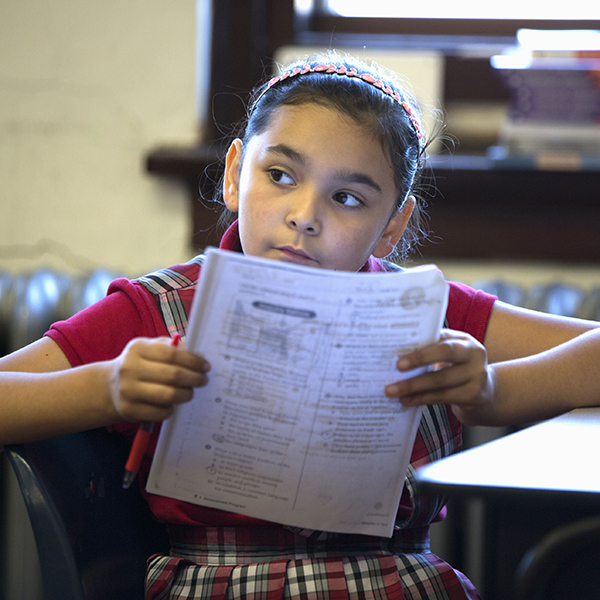
Minnesota has one of the largest education achievement gaps in the nation. According to a report from the Federal Reserve Bank of Minnesota, “Students’ educational disparities are deep, wide and persistent.” In 2017, the GHR Foundation partnered with FHI 360 to strengthen urban Catholic schools in Minnesota. They engaged in a process of analyzing student performance data collected several times throughout the academic year and using findings to target specific school improvement strategies, close student achievement gaps and promote best practices in data collection, assessment and use. Interactive data dashboards, created by FHI 360, provided at-a-glance views of key performance indicators on overall student performance and by subgroups. These tools helped school staff analyze and compare achievement results for students by race/ethnicity, home language, gender, socio-economic status and special education status. Results by subject and grade level were easier to compare, and school leaders now have the information they need to improve individual student needs. Jane Bona is the principal in one of the participating schools, Immaculate Conception.
Please give us a brief background about yourself and your school.
I have been the principal at Immaculate Conception for nine years. Before that, I was a teacher and curriculum developer in the public school system for 30 years. I was raised in Catholic schools, so becoming principal at Immaculate Conception was like coming home. Immaculate Conception is a co-ed facility that was opened in 1939. At one time, schools in the Twin Cities had a large student population and learning was not individualized. That has changed over time, and we now realize the importance of addressing each student’s needs. As of the 2019-20 academic year, 157 students at Immaculate Conception were enrolled in kindergarten through eighth grade, with an average of 15 students per grade.
What are some challenges you have noted during your career?
Over the past several years, demographics have changed, not only at Immaculate Conception but in urban areas generally. In the past three years alone, the number of Hispanic and Latinx students at the school has grown 64 percent. The English language learner (ELL) population has also increased. In 2016-17, we had only a few ELL students; this past year there were 45. As the population becomes more diverse, so do the challenges and opportunities. This is the new normal and, as a school, we have to keep up with the changes. Having access to data helps us to address the needs of our current student population.
How was data used to address those challenges at your school?
Through the data, we identified that our Hispanic and Latinx students were underperforming in reading. We also learned that mastering a new language could take as much as five to seven years. With this information, we understand more deeply how the written and spoken word may be misinterpreted by new students. I have a 1st grade student who enrolled one week ago, just arriving from Ecuador. The child is six years old and does not speak English. We know that even with our individualized instruction, he could be in the 7th grade before he masters English. That is both a tremendous responsibility and a wonderful opportunity!
To meet specific needs of students whose home language is not English, we have slowed down, provided more visuals and work in small groups. Teachers and staff share the data and work closely with the families so we can teach the whole child.
Is there anything you are doing differently as a result of your work with FHI 360?
The tools and support provided by FHI 360 have allowed our staff to view the data from several angles. We are able to see how our school’s achievement tests in mathematics and reading compared with the projected proficiency levels in the Minnesota state tests, enabling us to identify our strengths and weaknesses and adjust instruction.
The data also helps us to know where we need to promote best practices. For example, we can compare results from year to year and use last year’s data going forward. We know how each child performed in 1st grade and what that child will need to thrive in 2nd grade. We can ask ourselves, is there something we need to change institutionally?
FHI 360 workshops have helped us understand the tools and how they can help us identify challenges. Onsite instructional rounds allow individual schools to pose questions about challenges to participating educational leaders, who in turn ask clarifying and probing questions, conduct classroom walkthroughs and collaborate on potential action steps. During an instructional round we hosted at our school, I asked, “How do we ensure we are personalizing learning and getting the professional development we need?” It helped us realize that we needed to focus more on active learning for all students; learning where they can make choices and not just be passive.
Do you have any additional observations?
What’s happening at the school is a microcosm of conversations in education and the world today. Learning how to use data well allows us to understand the children behind the data. It is important to remember that it is about the children and the best way we can help each child learn.
This morning, I noticed that each of the four children presenting the pledge of allegiance has immigrant parents. Those parents left home and left their lives to improve their children’s lives here – I hope I am part of that dream.