
Skip to content
FHI 360
  • Languages
  • Low bandwidth
  • High bandwidth
  • Search
  • Who we are
        • Who we are
          • About us
          • Leadership
          • Ethics and safeguarding
          • Impact and financial reports
          • Contact us
        • About us

          Impact and financial reports

  • What we do
        • What we do
          • Economic opportunity
          • Health


        • How we do it
          • Research in action
          • Humanitarian response
          • Digital innovation and AI
        • Explore our expertise
        • Economic opportunity

          Health

  • Where we work
        • Where we work
          • Asia Pacific
          • Central Africa
          • East Africa
          • West Africa
          • Southern Africa
          • Middle East and North Africa
          • Europe and Central Asia
          • Latin America and the Caribbean
          • United States
        • Around the world

          In the United States

  • Work with us
        • Work with us
          • Join our team
          • Local partners
          • Government and multilateral funders
          • Foundations and corporations
          • Academic and research partners
          • Small businesses and vendors
        • Join our team

          Local partners

          Government and multilateral funders

          Foundations and corporations

          Academic and research partners

          Small businesses and vendors

  • News & events
        • News
          • Newsroom
          • Events
        • Get the latest news
        • Newsroom

          Events

  • Stories & blogs
        • Stories & blogs
          • Stories
          • Videos (YouTube)
          • Blog
        • Explore our storytelling
        • Our storytelling

          Blog

  • Resources
        • Resources
          • Resource library
        • Resource library

Home | Expertise | SCALE+ methodology | Formulate a common agenda

SCALE+ methodology

Formulate a common agenda

Creating a common agenda prepares stakeholders identified through mapping activities for committing to collective actions. The project’s Systems Integration (SI) Team facilitates strategic planning meetings with diverse stakeholder groups to steer them away from conflict and disagreement and set their focus on their common interests. When applying SCALE+ in optimum conditions, the project convenes a stakeholder-engagement event called a Whole-System-in-the-Room (WSR) retreat that gathers individuals identified and nominated during the mapping component. SCALE+ experts lead participants through 16 hours of self-managed exercises, jumpstarting the process of catalyzing coalitions and partnerships in order to commit to shared goals, catalyze coalitions, and determine pathways to system transformation.
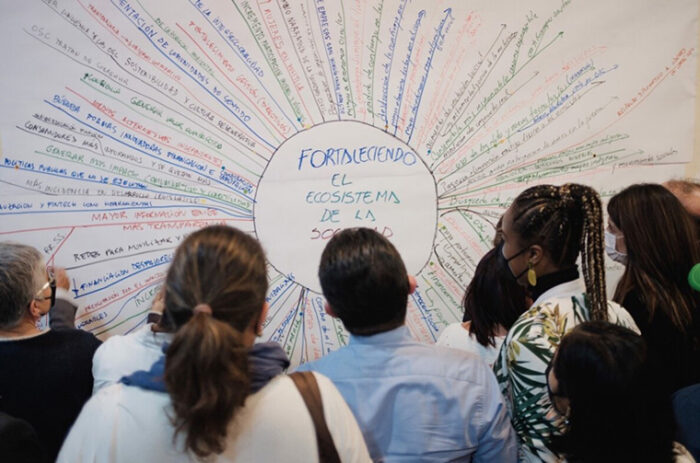
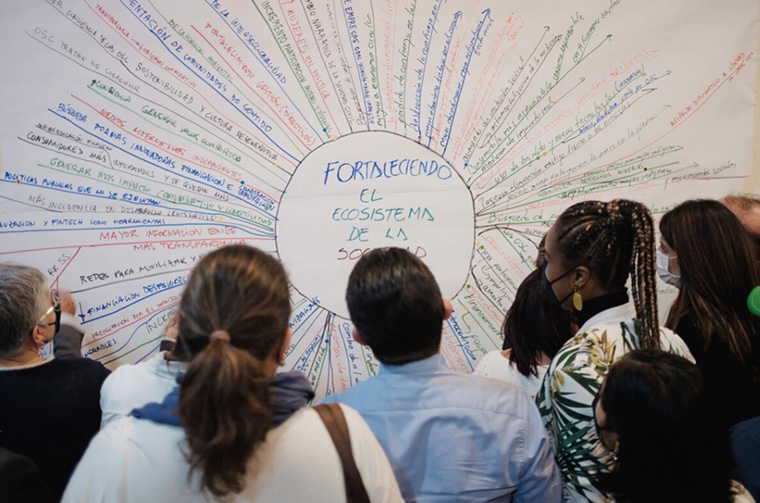
Representatives of multiple sectors use a visual exercise to identify trends affecting civil society in Colombia during a Whole-System-in-the-Room event in Bogotá sponsored by the Strengthening Together Activity (STA), which is funded by USAID and implemented by FHI 360. STA aims to improve the capacity and performance of 35 Colombian organizations. Photo credit: Andrés Felipe Castilla for FHI 360

Commit to shared goals  

SCALE+ uses the Future Search WSR technique to help diverse stakeholders find their common ground and commit to collective actions. The WSR is a collaborative event that convenes approximately 64 to 100 participants representing eight to 10 relevant sectors and diverse perspectives. The two- or three-day retreat stimulates safe discussion about the development challenge and leads participants through self-managed exercises in which they determine their common goals and commit to collaborative actions. The agreed-upon goals and the pledged actions become essential elements of the project’s work plan.  

Catalyze coalitions  

Establishing common goals allows stakeholders to understand their responsibilities within the system, identify where coordination and synergy are possible, and invest their time and resources more fully in collaborative actions to support shared priorities. Stating intentions in a forum in front of peers to resist working in silos and commit to collective work provides incentive for everyone to remain accountable. After the WSR retreat, voluntary collaborative action circles and task forces are formed around the identified goals.  

Determine pathways to transformation  

The SI Team handles many of the partnership coordination tasks. As the system’s broker, it remains “neutral” while facilitating meetings and catalyzing coalitions among competitive stakeholders representing diverse interests and agendas. The SI Team maintains contact on a regular basis with all stakeholders and assists them in organizing meetings and events, sharing information, and remaining focused on their commitments and pathways to transformation. Sharing and publicizing the fulfillment of these promises helps maintain collective enthusiasm and momentum.  

Documents / Downloads
Applying the SCALE+ method: Formulate a common agenda
Share expertise
Back to top

SCALE+ methodology navigation

  • SCALE+ methodology
  • Invest in collaboration
  • Map the local ecosystem
  • Formulate a common agenda
  • Advance collective action
  • Measure results

On this page

FHI 360

We are a nonprofit organization that mobilizes research, resources and relationships so that people everywhere can access the opportunities they need to lead full, healthy lives.

  • Partner with us
  • Business opportunities
  • Contract mechanisms
  • Small business
  • Our FHI 360 network
  • Events
  • Employee access
  • Contact us
  • Press
  • Privacy notice
  • Ethics and safeguarding

FHI 360 Headquarters
359 Blackwell Street, Suite 200
Durham, NC 27701 USA
1.919.544.7040

Washington, D.C., Office
2101 L Street NW, Suite 700
Washington, DC 20037 USA
1.202.884.8000

Anti-trafficking statement

Connect

Sign up for our mailing list and receive the latest updates from FHI 360 straight to your inbox!

  • LinkedIn
  • Facebook
  • X
  • Youtube
  • Instagram

FHI 360 is the registered trade name of Family Health International.

  • Terms of use
  • Cookie notice
©2026 FHI 360
GDPR Cookie Banner

We are using cookies to give you the best experience on our website.

You can find out more about which cookies we are using or switch them off in .