Resources
Search
Filters
-
Fact sheet
Frequently Asked Questions About the Postsecondary Success Collaborative
This publication answers frequently asked questions about the Postsecondary Success Collaborative (PSC), formerly the Citi Postsecondary Success Program. PSC is a national initiative launched in 2008 by the Citi Foundation to build clear pathways to college success in Miami-Dade County, Philadelphia and San Francisco.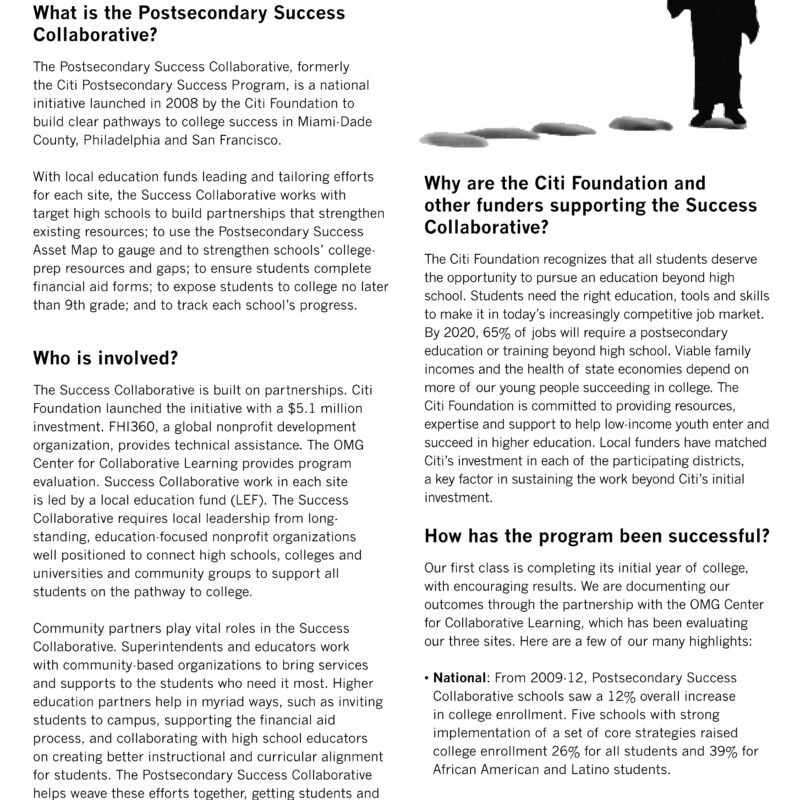
-
Fact sheet
Community-Based Access to Injectable Contraception: An Emerging Standard of Practice, 2008–2013
July 2013 — This two-page summary describes Program Research for Strengthening Sciences (PROGRESS) activities and impact related to community-based access to injectable contraceptives. PROGRESS is a five-year project awarded to FHI 360 by the U.S. Agency for International Development (USAID) in June 2008 to improve access to family planning among underserved populations.
-
Research paper or report
Research and Recommendations on the Delivery of Injectable Contraceptive Services by Patent Medicine Vendors in Rural Nigeria
-
Fact sheet
DMPA Sales at Licensed Chemical Shops in Ghana: Increasing Access and Reported Use in Rural and Peri-Urban Communities

-
Guide, manual or tool
Clinical Facility and Service Assessment Field Guide: Quality Assessment (QA) and Quality Improvement (QI)
2007 — This field guide is designed for use by FHI 360 staff and partner organizations responsible for ensuring quality clinical services, at both facility and non-facility levels. The guide provides general information on how to organize, implement and follow up on quality assurance/quality improvement clinical facility and service assessments. The accompanying checklists are intended to […]
-
Training material
Outreach Training Package (PDF in Arabic)
2013 — With funding from the Ford Foundation, FHI 360 developed a training package for outreach workers on the following topics: HIV and AIDs, sexually transmitted infections, hepatitis, harm reduction, positive living, and stigma and discrimination. The training package was designed to help build the capacity of outreach workers to effectively communicate with key audiences and […]
-
Guide, manual or tool
Life Skills Education Toolkit for Orphans and Vulnerable Children in India
October 2007 – This Life Skills Education Toolkit for Orphans and Vulnerable Children in India presents activities, modules and guides intended to help children and adolescents develop essential life skills to reduce the risk of sexually transmitted infections and HIV, manage HIV/AIDS, and identify and cope with difficult circumstances, including care and loss. The toolkit […]
-
Research paper or report
Out of School Children: Data Challenges in Measuring Access to Education
June 2013 — Large-scale estimates of out of school children are often taken at face value, without sensitivity to the extent of missing and incomplete information for a large number of countries, which affects the precision of regional and global aggregates. In addition, grey areas surrounding the definitions of primary school, non-formal education, and the target […] -
Guide, manual or tool
Social and Behavior Change Tools for People Living With HIV
2011 – These social and behavior change tools were designed by the Strengthening HIV/AIDS Response Partnership and Evidenced-Based Results (SHARPER) project, funded by the U.S. Agency for International Development, to help reduce HIV transmission among people living with HIV. A sample of tools produced under SHARPER includes: Introduction: Overview of My Life: Positive Living Toolkit […]
-
Fact sheet
Surveying Success To Help The Children of Bangladesh
2013 — Soil-transmitted helminths (STH) is a serious concern for children in Bangladesh. This brief explains how the End Neglected Tropical Diseases in Asia (END in Asia) project helped the Government of Bangladesh complete a series of surveys to determine whether the national Filariasis Elimination and STH Control program, which includes deworming activities through schools, has […]
Join our team
FHI 360 is an inclusive and innovative community of experts in more than 60 countries around the world, united by a shared goal: to open opportunities for people everywhere so they can lead full and healthy lives. Join us today.
Become a partner
We are committed to building equitable, collaborative relationships with governments, local communities, academic institutions, foundations and others working to open pathways to lasting change.