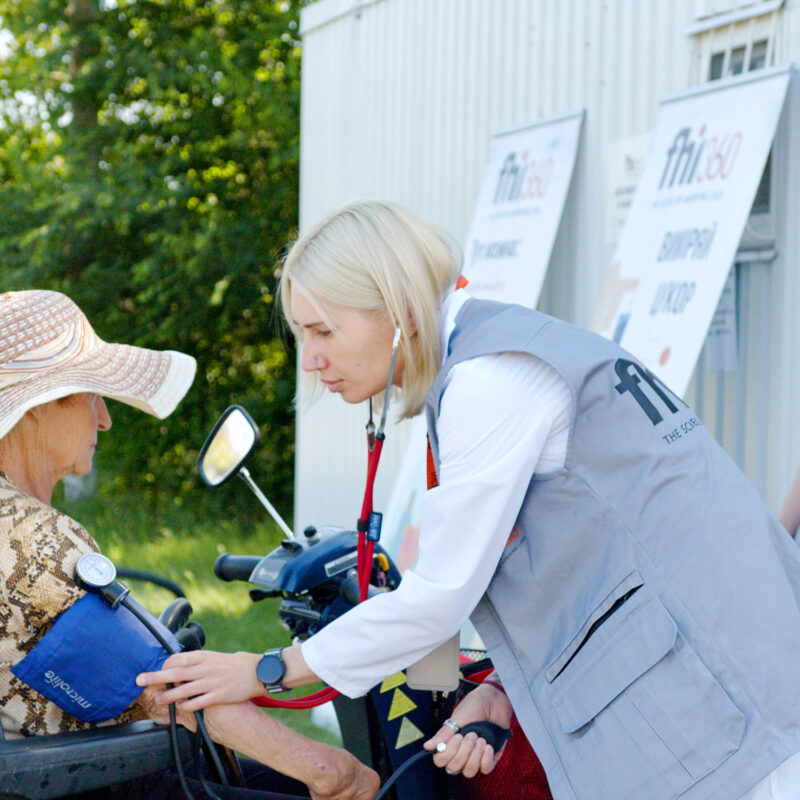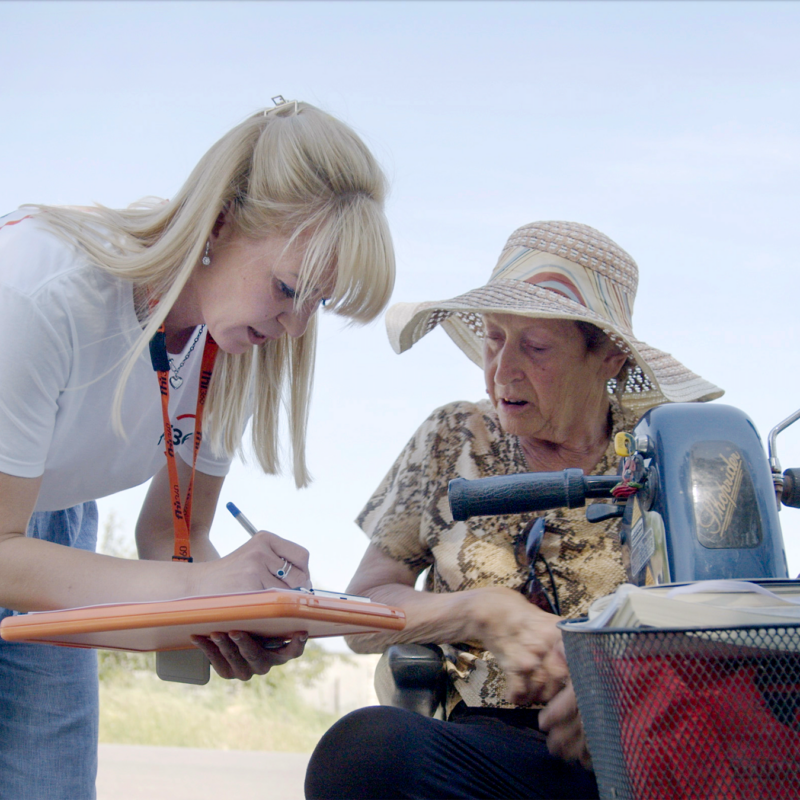



For Ukrainian veterans who have lost limbs to war, rebuilding a life means more than basic medical care. It requires access to custom-fitted prosthetics, home modifications, and rehabilitation support that allow them to move through the world with ease. Changing Lives with Innovative Funding (CLIF) is designed to meet this need.
In partnership with VIA Science, Inc. (VIA) and local veterans’ organizations in Dnipro, Ukraine, FHI 360 is piloting a flexible financial assistance model that puts resources directly in the hands of veterans. The model uses VIA Wallet, a blockchain-based payment system designed to overcome challenges in active conflict zones, such as the high transaction fees and foreign exchange risks that make conventional cash transfers and bank payments unreliable. In addition to technical assistance and access to its digital wallet technology, VIA will distribute $40,000 in direct assistance to participating veterans in the form of USD Coin (USDC), a stablecoin pegged 1:1 to the U.S. dollar and regulated under U.S. financial law. FHI 360 will identify and enroll eligible veterans and provide hands-on training and ongoing support to help both participants and vendors use the technology with confidence.
The need
Ukraine is now in its fifth year of full-scale conflict, and the humanitarian situation continues to intensify. An estimated 12.7 million people, roughly one in three Ukrainians, need humanitarian assistance. Veterans are among those with the most complex and under-resourced needs.
Approximately 1 million people in Ukraine, about 3% of the adult population, identify as veterans. Among them, 21% report living with a disability, and at least 100,000 are amputees. While the Ukrainian government covers basic prosthetics, significant gaps remain. Customized prosthetic components, home accessibility adaptations and personalized rehabilitation are largely out of reach for many veterans and their families.
FHI 360 has been working in Ukraine since the invasion began in February 2022, reaching more than 630,000 people with lifesaving health and protection services. CLIF builds directly on that presence and those relationships.
How it works
CLIF uses a simple, people-centered payment structure:
- FHI 360 identifies eligible veteran participants in partnership with a local veterans or rehabilitation organization and enrolls them in the program.
- Each participant receives support payments through their personal VIA Wallet.
- Participants use those funds to purchase needed products and services from a vetted network of local suppliers, paying directly through their VIA Wallet.
- Vendors receive payment instantly through their own VIA Wallet.
FHI 360 staff provide hands-on training and ongoing support to help participants and vendor partners set up and use their wallets with confidence. VIA provides initial resources, platform training, informational materials and technical support throughout implementation.
In Ukraine’s current environment, the digital wallet approach offers meaningful advantages over traditional transfer methods.
The funds will be distributed as USDC, offering reliability and protection from the volatility typically associated with other cryptocurrencies and creating an auditable, scalable transaction record. VIA’s wallet technology has been designed for disrupted environments like active war zones where internet and electricity are unreliable. This enables offline payments, meaning participants can use it to pay for goods or services, regardless of connectivity.
Scale and scope
The project launched as a three-phase pilot in Dnipro, running from May through November 2026. The first phase includes two months of start-up to establish partnerships and prepare the platform. The second phase encompasses four months during which 100 veteran participants each receive an average of $100 per month, totaling $40,000 in direct assistance through a generous seed investment from VIA. The funds are designed to supplement existing government support, providing items like specialized prosthetic components and home accessibility adaptations such as ramps and handrails. The third phase includes one month of post-distribution monitoring, participant feedback collection and final reporting.
If results support scale-up, the model could expand to additional cities, serve more participants, include veterans with other rehabilitation needs and extend to civilians with limb loss caused by explosive ordnance.
What we’re measuring
By the end of the project, FHI 360 expects to achieve:
- 100 veterans enrolled and supported.
- $40,000 transferred directly to participants.
- 100% of participants spend funds on disability-related products or services.
- At least 80% of participants report that funds were sufficient, quality of purchases was satisfactory, and their functionality or well-being improved.
- At least 80% of participants and vendors report that VIA Wallet transactions outperformed traditional alternatives by providing a more secure and reliable method than cash or bank transfers.
Monthly progress reports and a final performance report will capture outcomes and qualitative feedback from participants and vendor partners, along with lessons learned to inform future programming.
Frequently asked questions
How is FHI 360 using digital wallets in humanitarian response?
FHI 360 is piloting a blockchain-based payment model in Dnipro, Ukraine, that delivers flexible financial assistance to veterans with limb loss through the VIA Wallet and USDC stablecoin. Rather than relying on traditional cash transfers or bank payments — which carry high transaction fees and foreign exchange risk in active conflict settings — the CLIF project sends funds directly to each participant’s personal VIA Wallet. Veterans then use those funds to purchase customized prosthetics, home accessibility adaptations or rehabilitation services from a vetted network of local suppliers, who receive payment instantly through their own VIA Wallet. The approach is cost-efficient, settles in a stable currency to protect against hryvnia (Ukraine’s currency) volatility, and creates a transparent transaction record that supports monitoring and scale-up. FHI 360 provides hands-on training and ongoing support to help both participants and vendors use the technology with confidence.
What outcomes is FHI 360 measuring in its Ukraine veteran support pilot?
In its CLIF pilot in Dnipro, Ukraine, FHI 360 is tracking both financial and human outcomes across 100 veteran participants with limb loss. On the program side, targets include $40,000 in direct assistance transferred, provided through a generous initial grant from VIA, and 100% of funds spent on disability-related products or services. On the human side, FHI 360 is measuring whether participants report improved functionality or well-being, satisfaction with the quality of goods and services purchased, and whether the digital wallet experience was better than conventional payment methods like cash or bank transfers. The same satisfaction benchmarks apply to vendor partners. Data is collected through post-distribution monitoring surveys on a bimonthly basis, with monthly progress reports and a final performance report that includes qualitative feedback and lessons learned for future scale-up.