






During middle school, I was fascinated with the natural world. At home, I enjoyed playing outside and finding bugs and butterflies. When my parents called me in for dinner, they often had to coax me out of a tree. In school, I was equally curious. I remember the excitement I felt in my sixth-grade biology class when my teacher dissected a cow’s lung. I patiently waited in line to put my entire right arm into the esophagus.
My interest in science and math had few boundaries. I dissected earthworms and frogs, and a cow’s eye for extra credit. I cared for a display of African violets in the back of the classroom, mixing and measuring soil amendments and water, and monitoring fluorescent light exposure as I watched and calculated their rate of growth.
The problem was that I was doing some of this while other students were diving deeper into the curriculum with the teacher. I was not engaged in learning the new material. At the time, I didn’t stop to think about why the teacher chose to teach the lesson while I was doing other things. I thought I was lucky to be able to explore independently instead of participating in the lesson — but I also knew that something was wrong.
Over the years, I’ve wondered what I might be doing today had one of my teachers picked up on my interests. What if my interests had been nurtured and developed to a point where I perceived myself as someone who could do — and succeed in — a STEM (science, technology, engineering and mathematics) career? I was the only African-American student in my class. What perceptions and biases did my teachers have about my intellectual abilities? Would they have thought that my earning a doctoral degree was improbable?
In middle school, children develop their identities and make choices that impact their future careers. It’s a small window of time when teachers, counselors and other school personnel are in a key position to communicate consciously — and unconsciously — what they believe children may be capable of doing.
Teachers’ perceptions about what Black and Latinx students are capable of affect whether the students have access to advanced STEM courses, which textbooks are chosen and how principals assign teachers. Negative narratives also make students susceptible to “stereotype threat,” wherein they internalize damaging narratives about their abilities and fulfill the negative stereotype by performing poorly in their classes and on exams. These factors create an environment in which students of color are ultimately disenfranchised from studying and pursuing STEM courses and careers.
FHI 360 has a long history of leading research and implementation projects that improve STEM engagement and achievement for young people traditionally underrepresented in STEM careers. Our recent publication in the International Journal of Mathematical Education in Science and Technology offers a systemic review of the importance of girls’ mathematical identity in U.S. STEM programs in contributing to their academic performance, participation and persistence in mathematics. And over the past two years, in the wake of growing calls for racial and social justice, we’ve redoubled our efforts to address racial inequities in formal and informal STEM education.
We believe that there needs to be a radical shift in the often-unspoken assumptions about who excels in math and science. A new narrative must reflect the truth: Talent is distributed equally, all children are born with the ability to learn, and all students deserve to have their talents nurtured, equitably.
Recent research supports our belief. It shows that when STEM faculty believe intelligence is malleable and can be developed, all students in those environments demonstrate greater academic achievement than students with professors who believe intellect is fixed. Additionally, academic achievement among Black, Latinx and Native American students is even higher when they have teachers with a growth mindset. In other words, teachers’ attitudes and beliefs have a direct effect (positive and negative) on student performance — and it’s even more important for students of color.
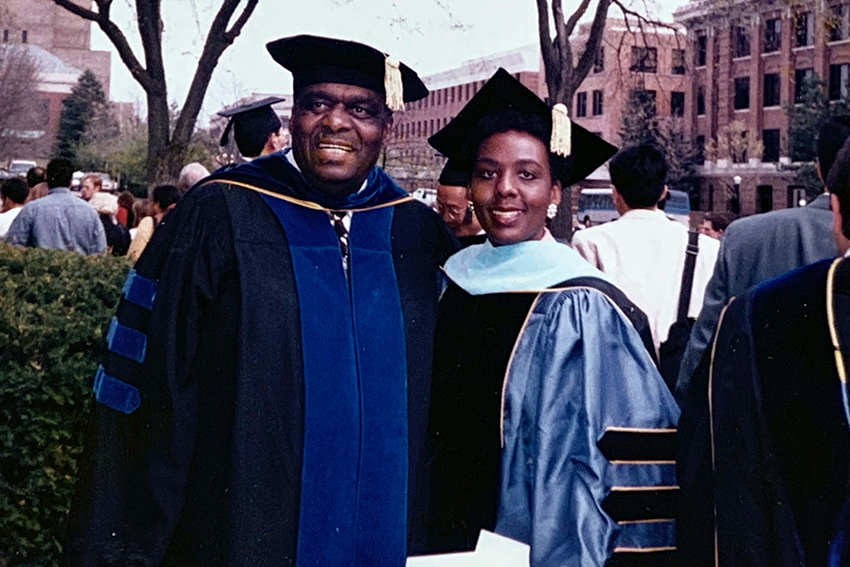
I was fortunate in that I always knew that I would go to college; both of my parents earned graduate degrees and attending college was expected. In the long run, my interests in researching the world around me stuck and I achieved my goal to earn a PhD, like my father, whose belief in me greatly influenced my belief in myself. Today, I work with FHI 360 to change the narrative for all young people — especially young people from historically marginalized backgrounds — so that they can grow and learn in supportive environments that build their talents and embrace their brilliance.