
The Cookie Jar is a Facebook group run by FHI 360’s Accelerating Progress in Communities (APC 2.0) project to support young women in Botswana in shifting social and gender norms. Members talk about issues like HIV risks, gaps in knowledge about infections and access to treatment. Typically, young women like me do not use HIV services despite risks of infection or violence in relationships. In Botswana, many young women engage in intergenerational and transactional sex. The Cookie Jar provides a place for young women to seek information, find out how to get care and receive peer support.
As a content manager, I ensure that the Cookie Jar serves as a confidential, safe and nonjudgmental place for peers to discuss health and well-being, relationships, fashion, music, makeup, etc. FHI 360 recruited me, along with other girls, to work with project staff in developing the logo, vision, goals and standard operating procedures for the Cookie Jar. To get us started, APC 2.0 staff trained and mentored me and my fellow content managers on posting and managing discussions ranging from HIV risks, gender-based violence (GBV) prevention messages, social asset building and screening for HIV testing.
The content managers encourage access to HIV preexposure prophylaxis (PrEP) and linkages to services using forum questions, videos, memes, images, quotes and stories. We also learned how to make and edit our own video content. We find ways to reach and support rural peers who do not have easy or steady access to Facebook.
Some of the successes in the past five years include:
- Increasing our membership to more than 1,000 young women, focusing on the greater Gaborone area. Much of this push has been by current members recruiting their own friends.
- Creating partnerships and linkages with local facilities. For example, the Tebelopele Voluntary Counseling and Testing Centre (TVCTC) set up clinical hours and safe spaces for young women to receive services.
- Supporting APC 2.0 to meet PEPFAR targets. From October 2019 through September 2020, the Cookie Jar referred young women for various services. In total, 78 young women received referrals: 20 sought HIV PrEP services, 31 received contraceptives, 21 sought HIV testing services and six sought gender-based violence care and general counseling services.
One member of the Cookie Jar had this to say:
“Hey Admin, I would like to thank you for the job well done y’all are doing. I say this because I barely comment in the group, I think cause I’m inferior I don’t know why. But yes. This group has been very beneficial to me. I’ve come to learn a lot from it. One thing I was afraid to start was PrEP, mainly because it’s controversial. But hey precaution is not promiscuity!
I find PrEP to be very useful and effective, I wish a lot of young women used it. Please don’t assume I’m taking it because I don’t trust my partner, I do trust him just not fully. He has his own weaknesses, so do I. So, for me PrEP gives me the full confidence of protection at all times. My wish is to see multitudes of young women to be enrolled on PrEP. Festive season is looming, and it can be a reckless season. I just wanted to say thank you so much Cookie Jar. ”
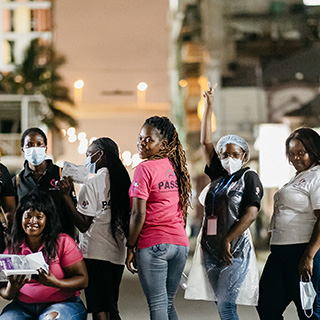
Members promote FHI 360 during community outreach events. Our work has even been showcased to the U.S. Ambassador to Botswana and the First Lady of Botswana. These exciting experiences proved that the Cookie Jar’s partnership with FHI 360 has value. In 2019, I participated in World AIDS Day celebrations in Maun, where young women were eager to learn about and enroll in HIV PrEP. However, PrEP is currently provided in Gaborone and Molepolole only. My goal this year is to work with FHI 360 to explore making PrEP accessible to young women in Maun.
For me, I feel most satisfied with how I am part of a strong team of young women who identify, link and support other young women living with HIV to initiate treatment and achieve viral suppression. In this role, I have personally grown and learned a lot. I am driven by passion to serve as a mediator for my fellow young women. The Cookie Jar is like having a noncoerced sisterhood that you can always rely on. It has given me tremendous hope. It has been five years of growth from a content manager to an intern at FHI 360, where I continue to support, coordinate, develop and manage content for this crucial group.