







Skip to content
FHI 360
  • Languages
  • Low bandwidth
  • High bandwidth
  • Search
  • Who we are
        • Who we are
          • About us
          • Leadership
          • Ethics and safeguarding
          • Impact and financial reports
          • Contact us
        • About us

          Impact and financial reports

  • What we do
        • What we do
          • Economic opportunity
          • Health


        • How we do it
          • Research in action
          • Humanitarian response
          • Digital innovation and AI
        • Explore our expertise
        • Economic opportunity

          Health

  • Where we work
        • Where we work
          • Asia Pacific
          • Central Africa
          • East Africa
          • West Africa
          • Southern Africa
          • Middle East and North Africa
          • Europe and Central Asia
          • Latin America and the Caribbean
          • United States
        • Around the world

          In the United States

  • Work with us
        • Work with us
          • Join our team
          • Local partners
          • Government and multilateral funders
          • Foundations and corporations
          • Academic and research partners
          • Small businesses and vendors
          • CEO position specification
        • Join our team

          Local partners

          Government and multilateral funders

          Foundations and corporations

          Academic and research partners

          Small businesses and vendors

  • News
        • News
          • Newsroom
        • Get the latest news
        • Newsroom

  • Stories
        • Stories & blog
          • Stories
          • Videos (YouTube)
          • Blog
        • Explore our storytelling
        • Our storytelling

          Blog

  • Resources
        • Resources
          • Resource library
        • Resource library

Home | Blog | Model shows intersecting secondary impacts of COVID-19 in the United States
August 6, 2020

Model shows intersecting secondary impacts of COVID-19 in the United States

–Felix Fernandez, Principal Research Scientist, United States Programs, FHI 360
–Todd Phillips, Director, Social Marketing and Communication, FHI 360

The impact of the COVID-19 pandemic in the United States has been unlike anything most of us have seen in our lifetimes. Conditions such as stay-at-home orders, wearing masks in public and the highest unemployment rate since the Great Depression affect all of us in different ways.

While the country’s focus has been on preventing, detecting and managing COVID-19, the societal impact of the pandemic is far more widespread and will last for years, if not decades. Responses to control the pandemic have already had far-reaching effects on the national economy, city tax revenues, unemployment, education, the environment, health behaviors and public health and safety, among other areas. And, Black and Indigenous people and people of color are disproportionately bearing the brunt of these secondary impacts, just as they have disproportionately experienced the health impact of the virus.

To understand the full societal impact of COVID-19, especially among the populations that have been hit the hardest, we created a model that maps sectors affected by the pandemic. We will use this model to guide our own internal thinking as we adjust and adapt our ongoing programmatic efforts. We hope it will also help other organizations, communities and governmental agencies. Our intent is to provide an initial model that can be tailored and adapted as needed based on local conditions, populations and other factors.

Secondary impacts of the COVID-19 pandemic in the United States
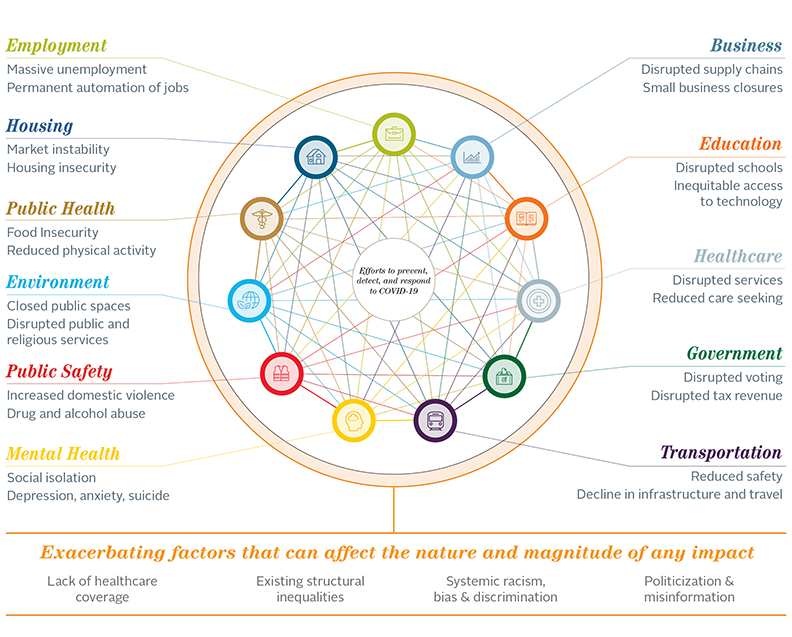
secondary model

We identified 11 sectors and accompanying examples of secondary impacts of COVID-19, alongside four exacerbating factors that can affect the nature and magnitude of any impact. For example, we recognize that structural inequities are a core underlying cause of the disproportionate impact on low-income and high-risk communities.

We do not assume that any individual sector is more important than another — rather that sectors will be impacted differently in different communities and that impacts in one sector will have cascading effects on others. For example, despite increased demand for health care professionals in response to COVID-19, cancellations and postponements of medical visits and procedures threaten existing revenues of hospitals and health care systems (business sector), create job loss in the health care sector (employment sector) and reduce access to preventive care (public health sector).

In another example, FHI 360 has partnered with Durham Public Schools in North Carolina to develop and implement a districtwide technology plan that incorporates distance learning in response to the pandemic. In addition to the need for distance learning (education sector), we know that the pandemic has affected families in other ways, such as employment, mental health, public health and transportation. As a result, we will be helping Durham Public Schools to incorporate social-emotional learning strategies into their distance-learning technology plan.

At FHI 360, we are committed to addressing the broad societal impacts we are seeing across the United States, especially among the populations who are disproportionately affected by this pandemic. We focus on improving the public health, education and workforce development of low-income communities and Black and Indigenous people and people of color through integrated approaches to the design, delivery and evaluation of programs with the potential to make a meaningful difference in their lives.

Please read our fact sheet.

Share blog
Back to top
FHI 360

We are a nonprofit organization that mobilizes research, resources and relationships so that people everywhere can access the opportunities they need to lead full, healthy lives.

  • Partner with us
  • Business opportunities
  • Contract mechanisms
  • Small business
  • Our FHI 360 network
  • Events
  • Employee access
  • Contact us
  • Press
  • Privacy notice
  • Ethics and safeguarding

FHI 360 Headquarters
359 Blackwell Street, Suite 200
Durham, NC 27701 USA
1.919.544.7040

Washington, D.C., Office
2101 L St NW, Suite 700
Washington, DC 20037 USA
1.202.884.8000

Anti-trafficking statement

Connect

Sign up for our mailing list and receive the latest updates from FHI 360 straight to your inbox!

  • LinkedIn
  • Facebook
  • X
  • Youtube
  • Instagram

FHI 360 is the registered trade name of Family Health International.

©2026 FHI 360

We are using cookies to give you the best experience on our website.

You can find out more about which cookies we are using or switch them off in .

FHI 360
Powered by  GDPR Cookie Compliance
Privacy overview

This website uses cookies so that we can provide you with the best user experience possible. Cookie information is stored in your browser and performs functions such as recognising you when you return to our website and helping our team to understand which sections of the website you find most interesting and useful.

Essential cookies

Essential cookies should be enabled at all times so that we can save your preferences for cookie settings. However, they can be enabled or disabled using the button below.

Non-essential cookies

This website uses Google Analytics to collect anonymous information such as the number of visitors to the site, and the most popular pages.

Keeping this cookie enabled helps us to improve our website.