




Skip to content
FHI 360
  • Languages
  • Low bandwidth
  • High bandwidth
  • Search
  • Who we are
        • Who we are
          • About us
          • Leadership
          • Ethics and safeguarding
          • Impact and financial reports
          • Contact us
        • About us

          Impact and financial reports

  • What we do
        • What we do
          • Economic opportunity
          • Health


        • How we do it
          • Research in action
          • Humanitarian response
          • Digital innovation and AI
        • Explore our expertise
        • Economic opportunity

          Health

  • Where we work
        • Where we work
          • Asia Pacific
          • Central Africa
          • East Africa
          • West Africa
          • Southern Africa
          • Middle East and North Africa
          • Europe and Central Asia
          • Latin America and the Caribbean
          • United States
        • Around the world

          In the United States

  • Work with us
        • Work with us
          • Join our team
          • Local partners
          • Government and multilateral funders
          • Foundations and corporations
          • Academic and research partners
          • Small businesses and vendors
          • CEO position specification
        • Join our team

          Local partners

          Government and multilateral funders

          Foundations and corporations

          Academic and research partners

          Small businesses and vendors

  • News
        • News
          • Newsroom
        • Get the latest news
        • Newsroom

  • Stories
        • Stories & blog
          • Stories
          • Videos (YouTube)
          • Blog
        • Explore our storytelling
        • Our storytelling

          Blog

  • Resources
        • Resources
          • Resource library
        • Resource library

Home | Articles | Mobile medical clinics expand health care access in Ukraine
September 30, 2025

Mobile medical clinics expand health care access in Ukraine

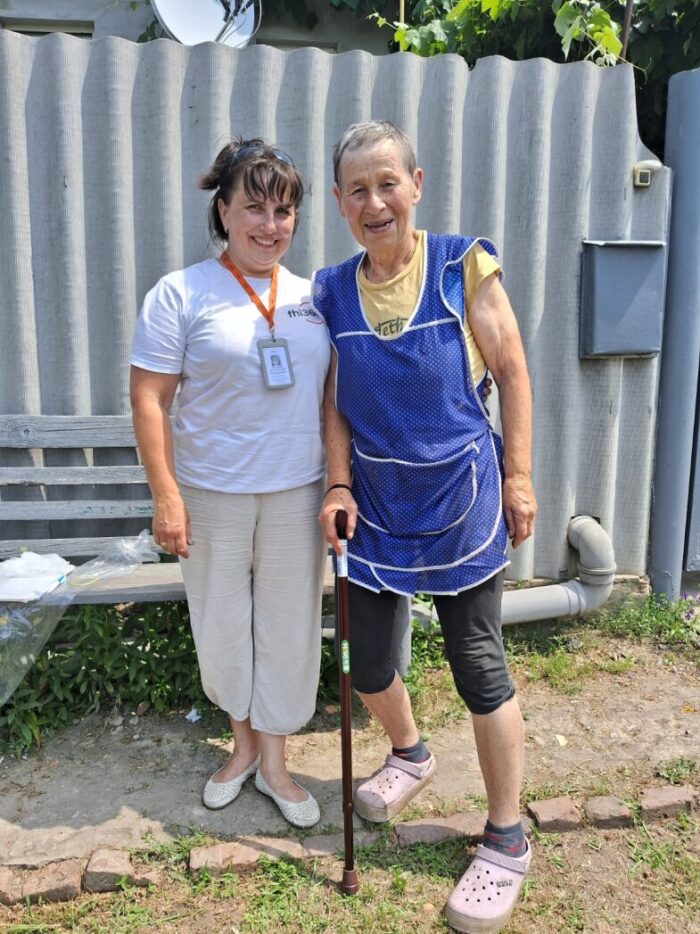
Two women are standing outside smiling, one is leaning on her cane, and the other is wearing her mobile medical team badge.
Sofiia (right) was struggling to walk before she received rehabilitative health care from FHI 360 Rehabilitation Specialist Olena (left); now, after Olena taught her physical exercises and helped her access a cane, she is more mobile and independent. Photo credit: FHI 360

For Sofiia, 81 – a former milkmaid and electrician living with her 58-year-old son, who is blind – visits with members of a mobile medical team gave her a second chance at life.  

When her village in Ukraine’s Kharkiv region was under occupation, Sofiia began experiencing debilitating knee and back pain. It was so severe that she struggled to leave her home. 

Sofiia sought help from a family doctor who works for one of FHI 360’s mobile medical teams in Ukraine. Her “first impression of the FHI 360 team was very positive,” she says. “The family doctor carefully talked to me, examined me, prescribed treatment [and] medication, and referred me to a rehabilitation specialist” on the team, Olena Lutsenko. 

Olena sees five or six patients a day. They often suffer from issues such as joint pain, lower back pain and chronic stress symptoms like anxiety and poor sleep.  

“At the first visit, Sofiia was depressed and did not really hope for an improvement in her condition,” says Olena.

Mobile medical teams provide health care to conflict-affected communities 

War has weakened the social infrastructure of communities like Sofiia’s, diminishing access to basic services at a time when more people need access to health care. In July 2025, the country hit a grim milestone, with the number of civilians killed and injured reaching a three-year monthly high, according to the UN Human Rights Monitoring Mission in Ukraine. “Whether you are in a hospital or a prison, at home or at work, close to or far away from the frontline, if you are in Ukraine today, you are at risk of getting killed or injured by the war,” says Danielle Bell, head of the UN Human Rights Monitoring Mission in Ukraine. 

To reach communities like Sofiia’s in Southern and Eastern Ukraine, FHI 360 implements the Ukraine Humanitarian Assistance Response Program, with support from the U.S. Department of State. Through the project, FHI 360 manages 11 mobile medical teams working in conflict-affected areas, offering health services, including rehabilitative care, to people who need them.  

Olena showed Sofiia how to perform simple exercises to lessen her pain, strengthen her balance and improve her mobility. She also gave her a cane, which has helped her increase her independence.  

After six weeks, Sofiia’s balance improved, her pain levels decreased, and her confidence grew. She was able to move freely again – walking to the store, moving around her yard, doing household chores – which improved her overall mood.  

Ukraine is one of the “oldest” countries in the world – nearly a quarter of its population is over the age of 60. Older people can have more extensive medical needs and during conflict, they are at a heightened risk of experiencing violence, according to Amnesty International. As a result, there are many people like Sofiia in need of care. 

As of August 2025, FHI 360’s teams had provided rehabilitative care to more than 2,200 people. These teams deliver services directly, visiting those with limited mobility in their homes and holding clinic hours at existing health posts. They often travel to remote communities to supply local residents with rehabilitation resources and assistance. 

Hope and healing amid war 

For Sofiia, the support that she received from FHI 360 “helps maintain hope for an end to the war in Ukraine and the return of peace.” 

FHI 360’s rehabilitation specialists, like Olena, take a personalized, compassionate approach to meeting each patient’s needs. Beyond simply selecting and fitting assistive devices, specialists offer ongoing training and care, helping to restore people’s independence and improve their quality of life. 

Each assistive device is more than just equipment – it can be a lifeline for those enduring the harsh realities of life in rural, conflict-affected areas. Often, says Olena, a person will need several assistive devices that can improve their quality of life. 

Olena remains committed to supporting her patients with the health care they need.  

Share article
Back to top

Related articles

News
New AI chatbot aims to boost teacher pedagogical support
May 11, 2026
News
Why more employers are turning to apprenticeships — and seeing results
April 24, 2026
News
Investing in hope: How Nigerian women are building economic opportunities
April 16, 2026

On this page

FHI 360

We are a nonprofit organization that mobilizes research, resources and relationships so that people everywhere can access the opportunities they need to lead full, healthy lives.

  • Partner with us
  • Business opportunities
  • Contract mechanisms
  • Small business
  • Our FHI 360 network
  • Events
  • Employee access
  • Contact us
  • Press
  • Privacy notice
  • Ethics and safeguarding

FHI 360 Headquarters
359 Blackwell Street, Suite 200
Durham, NC 27701 USA
1.919.544.7040

Washington, D.C., Office
2101 L St NW, Suite 700
Washington, DC 20037 USA
1.202.884.8000

Anti-trafficking statement

Connect

Sign up for our mailing list and receive the latest updates from FHI 360 straight to your inbox!

  • LinkedIn
  • Facebook
  • X
  • Youtube
  • Instagram

FHI 360 is the registered trade name of Family Health International.

©2026 FHI 360

We are using cookies to give you the best experience on our website.

You can find out more about which cookies we are using or switch them off in .

FHI 360
Powered by  GDPR Cookie Compliance
Privacy overview

This website uses cookies so that we can provide you with the best user experience possible. Cookie information is stored in your browser and performs functions such as recognising you when you return to our website and helping our team to understand which sections of the website you find most interesting and useful.

Essential cookies

Essential cookies should be enabled at all times so that we can save your preferences for cookie settings. However, they can be enabled or disabled using the button below.

Non-essential cookies

This website uses Google Analytics to collect anonymous information such as the number of visitors to the site, and the most popular pages.

Keeping this cookie enabled helps us to improve our website.