
Skip to content
FHI 360
  • Languages
  • Low bandwidth
  • High bandwidth
  • Search
  • Who we are
        • Who we are
          • About us
          • Leadership
          • Ethics and safeguarding
          • Impact and financial reports
          • Contact us
        • About us

          Impact and financial reports

  • What we do
        • What we do
          • Economic opportunity
          • Health


        • How we do it
          • Research in action
          • Humanitarian response
          • Digital innovation and AI
        • Explore our expertise
        • Economic opportunity

          Health

  • Where we work
        • Where we work
          • Asia Pacific
          • Central Africa
          • East Africa
          • West Africa
          • Southern Africa
          • Middle East and North Africa
          • Europe and Central Asia
          • Latin America and the Caribbean
          • United States
        • Around the world

          In the United States

  • Work with us
        • Work with us
          • Join our team
          • Local partners
          • Government and multilateral funders
          • Foundations and corporations
          • Academic and research partners
          • Small businesses and vendors
          • CEO position specification
        • Join our team

          Local partners

          Government and multilateral funders

          Foundations and corporations

          Academic and research partners

          Small businesses and vendors

  • News
        • News
          • Newsroom
        • Get the latest news
        • Newsroom

  • Stories
        • Stories & blog
          • Stories
          • Videos (YouTube)
          • Blog
        • Explore our storytelling
        • Our storytelling

          Blog

  • Resources
        • Resources
          • Resource library
        • Resource library

Home | Articles | Finding hope in the kitchen
May 18, 2022

Finding hope in the kitchen

“Man nuh dead, nuh call him duppy” (“If a man isn’t dead, don’t call him a ghost”) — a Jamaican proverb meaning that with the right support, anyone can rise against the odds.

That’s the story of Omar Johnson*, whose life took a 180-degree turn for the better when he least expected it.

Omar, now 33, grew up in an under-resourced community in St. James Parish on Jamaica’s northwestern coast. The third of four children, he was raised by a single mother who operated a shop selling basic food items. She had trouble making ends meet; without money for lunch, bus fare or supplies, Omar often had to miss school. “I was bright, and I loved school, and being absent hurt my heart and soul,” he says.  

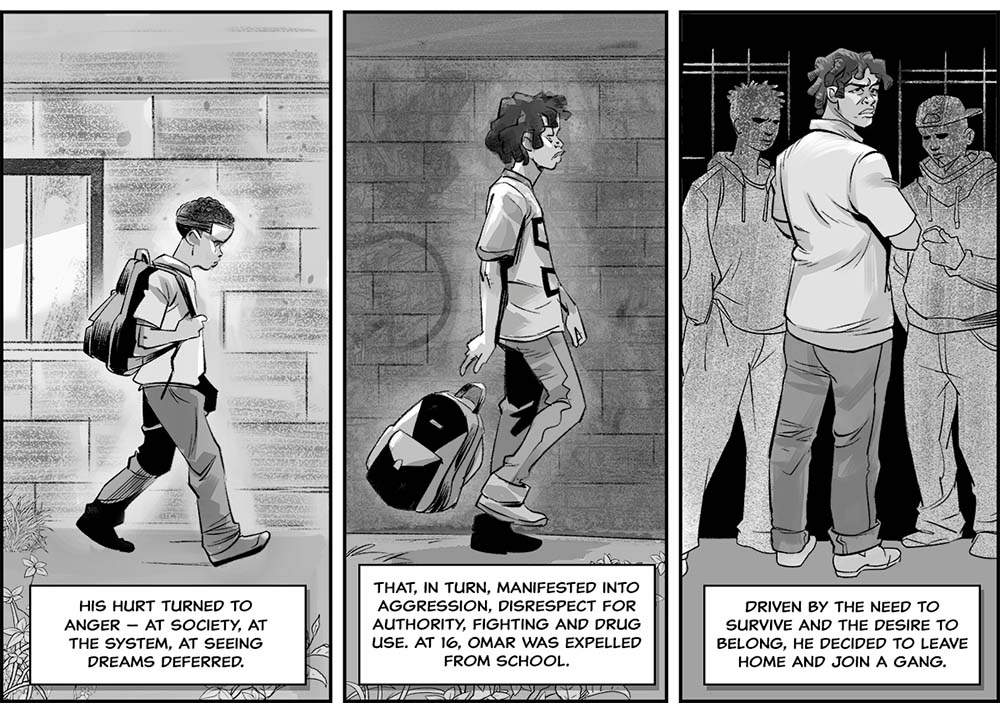
Omar reminisces about his past as a young teenager. In black and white, he is shown with short hair casually sitting on a couch with his school bag next to him and saying, In a close-up of Omar’s sad face and head hanging low, he states, “…and being absent from school hurt my heart and soul.”Omar is seen growing older over the years walking and eventually leaving his school bag behind and joining a gang. His hurt turned to anger – at society, at the system, at seeing dreams deferred. That, in turn, manifested into aggression, disrespect for authority, fighting and drug use. At 16, Omar was expelled from school. Driven by the need to survive and the desire to belong, he decided to leave home and join a gang.

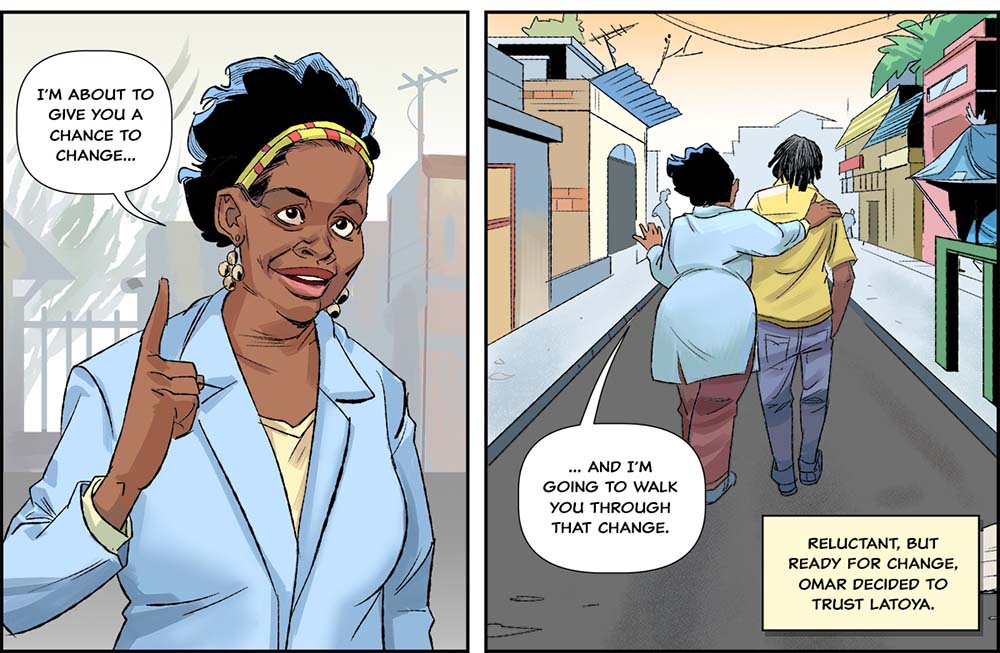
Omar is shown as a young adult walking in his neighborhood and meeting Latoya, an FHI 360 caseworker.The outlook for his future was grim, like it is for many other Jamaicans recruited at a young age into lives of crime and violence. Then, on the street, he met Latoya Nooks, an FHI 360 caseworker attached to the Local Partner Development (LPD) project, funded by the U.S. Agency for International Development (USAID).
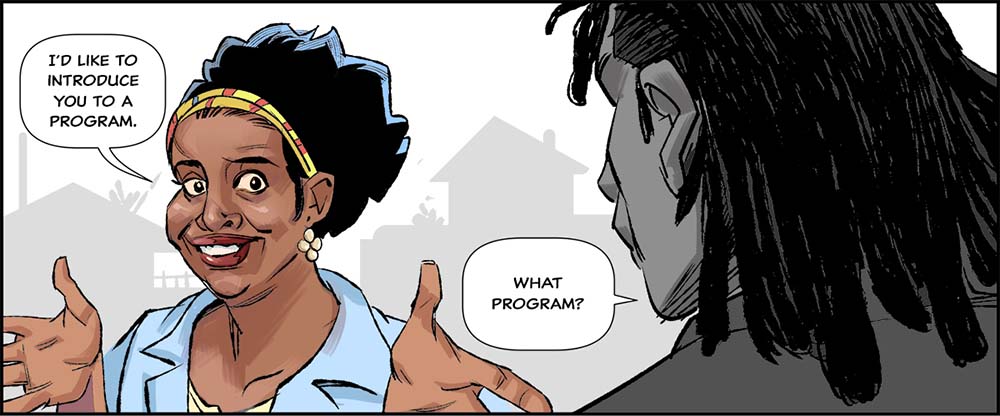
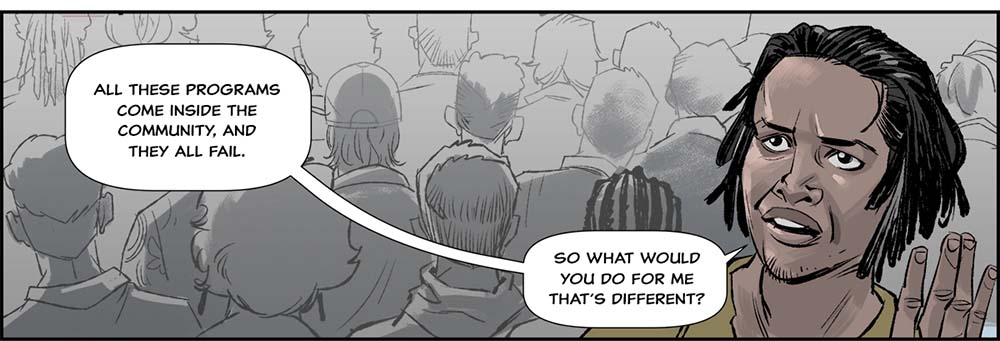
Wearing a blue blazer and with a smile on her face, Latoya exclaims, “I’d like to introduce you to a program.” Omar, shown with intricate dreadlocks, faces Latoya and responds, “What program?” In a close-up shot, Omar looks distressed. He is in front of a greyed-out background of the backs of several men walking away from him. He reluctantly says, “All these programs come inside the community, and they all fail. So, what would you do for me that’s different?”Latoya with a cheerful expression replies, “I’m about to give you a chance to change…” She places her arm placed on Omar’s shoulder while they walk down the street in his neighborhood. She continues, “…And I’m going to walk you through that change.” 
Reluctant, but ready for change, Omar decided to trust Latoya.

Through the LPD project, FHI 360 provides training and support to youth from under-resourced communities. Psychosocial support in particular — to process and release years of trauma — is a critical first step for young people traveling the path to a more productive future.
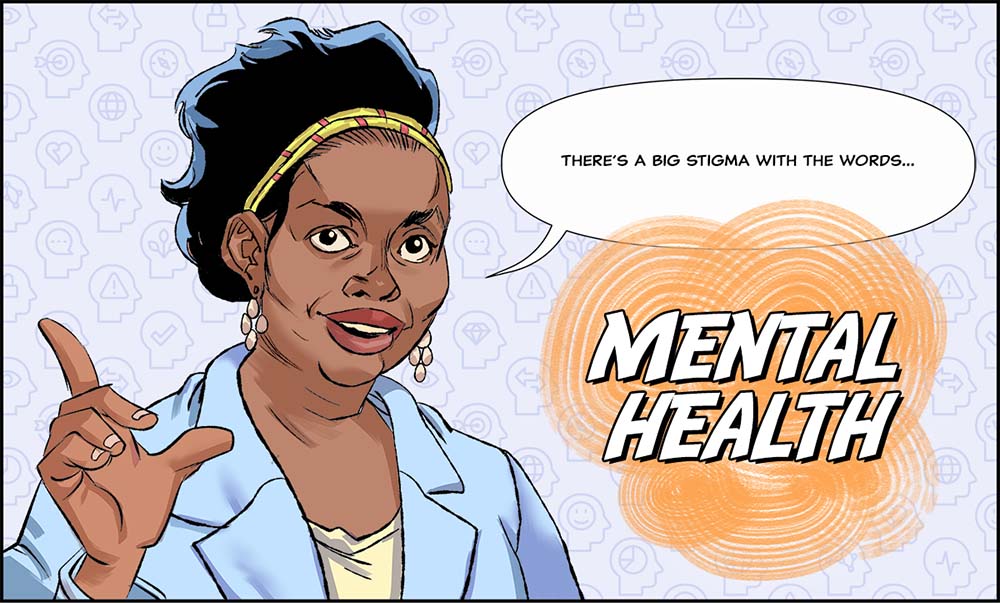
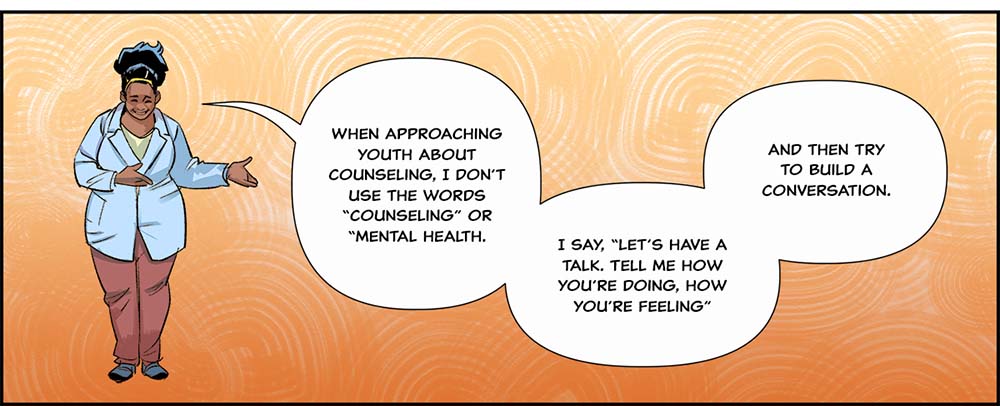
Latoya is pointing her finger up while sharing her thoughts in a monologue. She starts, “There’s a big stigma with the words…MENTAL HEALTH.” Next to her speech bubble, the words “mental health,” are highlighted in block letters in an orange cloud.In a full shot of Latoya, she is shown wearing a blue blazer and brown slacks with an orange cloud background. She explains further, “When approaching youth about counseling, I don’t use the words ‘counseling’ or ‘mental health.’ I say, ‘Let’s have a talk. Tell me how you’re doing, how you’re feeling.’ And then try to build a conversation.”

Omar is in a kitchen holding a skillet over an open fire with an instructor chef standing next to him. He is wearing a blue apron over his white shirt and jeans along with a blue chef’s hat. The instructor is wearing a similar blue apron and chef’s hat.Omar started receiving regular anger management support and began attending group sessions. Over time, he learned new ways to manage his emotions and cope with stress. He also took advantage of the opportunity to learn new skills, completing a food preparation program with HEART NSTA, a vocational training program.
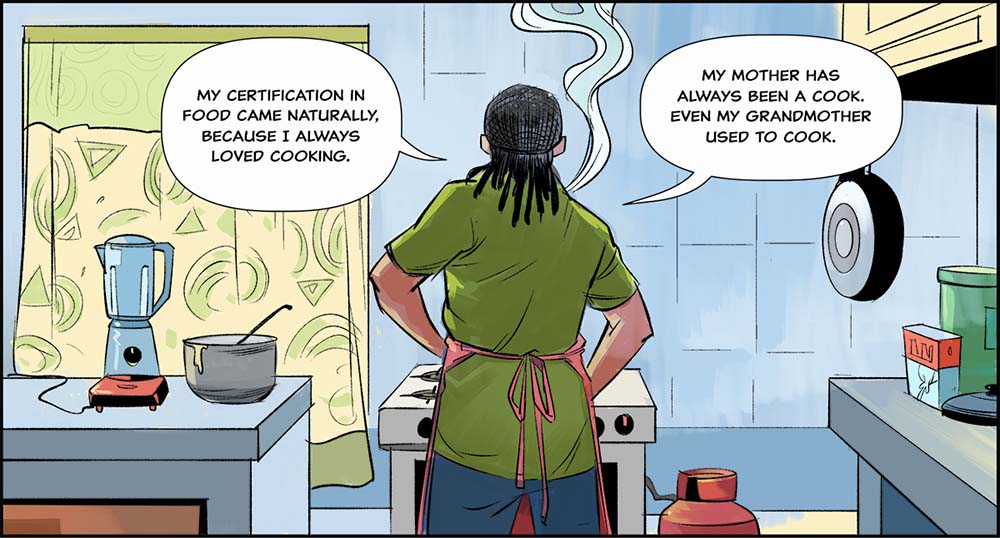
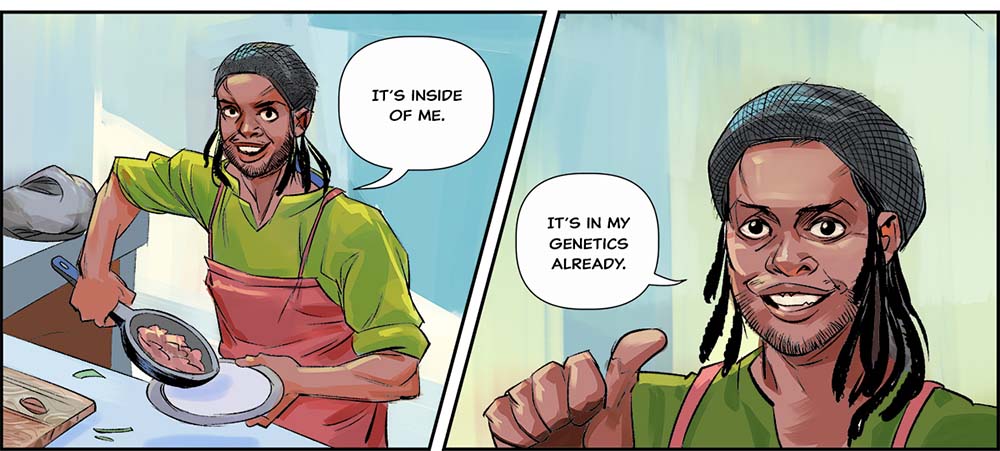
Omar is cooking in his own kitchen with his body faced away towards his stove hooked to a butane gas tank. He begins to explain, “My certification in food came naturally, because I always loved cooking.” “My mother has always been a cook, even my grandmother used to cook.” A blender, cooking scale, cake mix box, pots and pans are displayed on Omar’s kitchen counters.Omar is looking up and smiling while wearing a hair net and holding a small skillet with cooked food. He says, “It’s inside of me.” In a separate close-up, he points to himself and states, “It’s in my genetics already.”Omar’s hands are shown serving a full and colorful plate of Jamaican cuisine. While serving the plate he says, “I really love it. It takes my mind off other things.”

Today, more than 15 years after leaving school, Omar is focused on building a cooking and catering business. In 2020, as part of its response to the COVID-19 pandemic, FHI 360 provided about 1,000 Jamaicans, including Omar, with food vouchers and sanitation support. Omar used the vouchers to set up a cookshop at the house he shares with his mother, where he sells jerk chicken and other traditional dishes along with natural juices, such as soursop and mango. He completed a USAID business development course in July 2021 and has received appliances, including a stove and a rice cooker, to help him expand his business.

Omar, who still checks in with Latoya, encourages youth in his community to get the training and education they need to realize their dreams.

“When you’re literate, you’re going to make better decisions. When you’re skill-trained, you are more marketable, so you’re able to get yourself out of certain situations,” he says. “The advice I give to youth is that there is something more than what’s happening in your little community. …  Everybody has an opportunity or a chance to be better than themselves.”

For Omar, taking that chance changed his life.
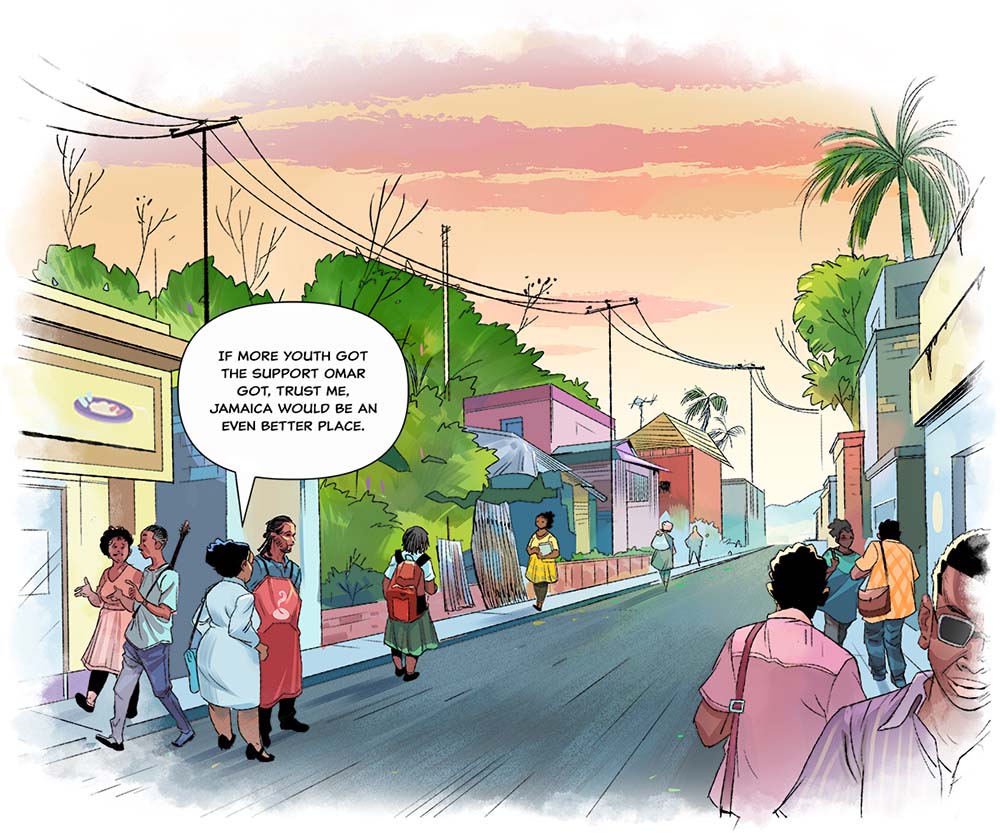
A bustling street scene is shown under a bright sunset sky. Omar and Latoya stand in front of Omar’s restaurant. Latoya is shown looking into the distance saying to herself, “If more youth got the support Omar got, trust me, Jamaica would be an even better place.”


*Name changed. All comic illustrations by TM Design, Inc.

Share article
Back to top

Related articles

News
FHI 360’s rapid response to the Ebola virus in the DRC
June 12, 2026
News
New AI chatbot aims to boost teacher pedagogical support
May 11, 2026
News
Why more employers are turning to apprenticeships — and seeing results
April 24, 2026

On this page

FHI 360

We are a nonprofit organization that mobilizes research, resources and relationships so that people everywhere can access the opportunities they need to lead full, healthy lives.

  • Partner with us
  • Business opportunities
  • Contract mechanisms
  • Small business
  • Our FHI 360 network
  • Events
  • Employee access
  • Contact us
  • Press
  • Privacy notice
  • Ethics and safeguarding

FHI 360 Headquarters
359 Blackwell Street, Suite 200
Durham, NC 27701 USA
1.919.544.7040

Washington, D.C., Office
2101 L St NW, Suite 700
Washington, DC 20037 USA
1.202.884.8000

Anti-trafficking statement

Connect

Sign up for our mailing list and receive the latest updates from FHI 360 straight to your inbox!

  • LinkedIn
  • Facebook
  • X
  • Youtube
  • Instagram

FHI 360 is the registered trade name of Family Health International.

©2026 FHI 360

We are using cookies to give you the best experience on our website.

You can find out more about which cookies we are using or switch them off in .

FHI 360
Powered by  GDPR Cookie Compliance
Privacy overview

This website uses cookies so that we can provide you with the best user experience possible. Cookie information is stored in your browser and performs functions such as recognising you when you return to our website and helping our team to understand which sections of the website you find most interesting and useful.

Essential cookies

Essential cookies should be enabled at all times so that we can save your preferences for cookie settings. However, they can be enabled or disabled using the button below.

Non-essential cookies

This website uses Google Analytics to collect anonymous information such as the number of visitors to the site, and the most popular pages.

Keeping this cookie enabled helps us to improve our website.