Tsegay Birhane Beyene has worked with FHI 360 since 2021. Prior to that time, he was a university lecturer in civil engineering and was self-employed as an engineer. When war broke out in his country, Tesgay saw a way to use his skills to help the people around him. A peace agreement was reached in 2022, but significant damage – and tensions – remain, making Tsegay’s work more critical than ever.
What is your day-to-day job with FHI 360?
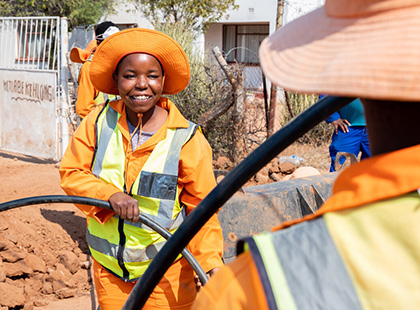
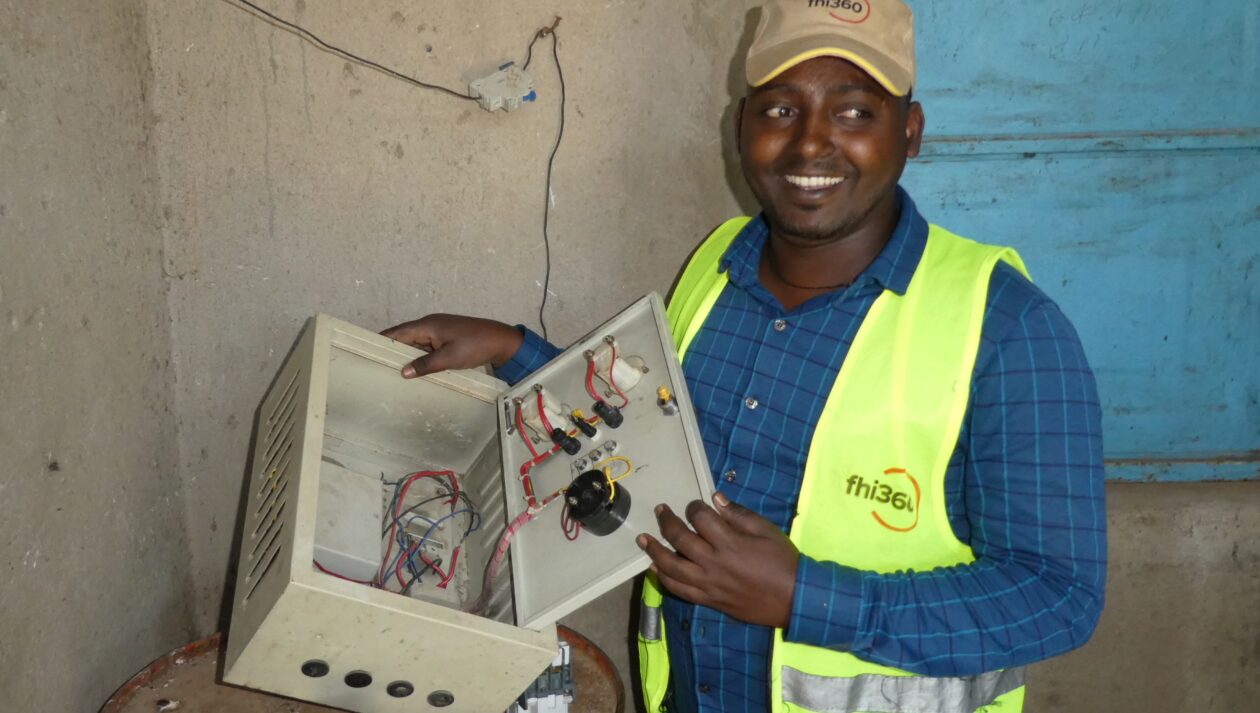
I am an engineer, focusing on water, sanitation and hygiene. For the last four years I have worked in this field, supporting people who fled conflict and are living in displacement camps. We construct or repair electromechanical water supply systems, build pipeline extensions and water storage tanks, monitor water quality, create systems to dispose of waste safely and prevent diseases like cholera. I also work on renovations and repairs for health facilities and schools.
What drew you to humanitarian work?
Starting in October 2020, all government services in the Tigray region stopped due to conflict. There was no internet or banking available, there was no public transport. At that time, I was living far from my family. In January 2021 I left on foot to try to find my family members. In my journey I saw people who had fled the conflict from different parts of the Tigray region and were faced with a shortage of clean water and sanitation facilities.
Once I saw it with my own eyes, I had to help make people aware of the risks. I urged them to dig their emergency pit latrines far from their sleeping place and talked to them about how to find safe water from their surroundings.
I saw people living in rural areas that were searching for water, walking 6 hours on foot. I vowed that I was going to do something about this crisis.
One day I was with my friends, drinking coffee, and saw a job vacancy notice with FHI 360. I applied and was one of ten candidates selected for an interview exam. I got the job in May 2021.
What do you love about the work you do?
My favorite part of my work is the fact that it is all about tangible human interaction. I do a better job if I can relate to or understand what makes the people I’m working with feel comfortable and satisfied, what aspirations they have and how they foresee their future.
My earliest dream was to be working in a field that aligns with my personal values. It’s a rare gift to be able to give back in a greater sense and on a global scale. I believe in the human ability to not only survive but also surmount shocks like natural disasters, wars and chronic conflict.
How has working as a humanitarian affected how you look at the world?
Since the moment I became a humanitarian worker, I developed a new perspective on everything around me, and I see the world differently. I am more conscious of people and their daily struggles to survive.
My work has helped me better understand who I am. I enjoy interacting or working with our program participants to find solutions to the problems they face. At the same time, my background has helped me relate to many of the people I’ve worked with over the years.
For me being a humanitarian means having human values and an understanding of all human situations that we share, regardless of race, ethnicity, religion and social status. It’s working towards common human goals and ensuring we support people with respect and dignity.