





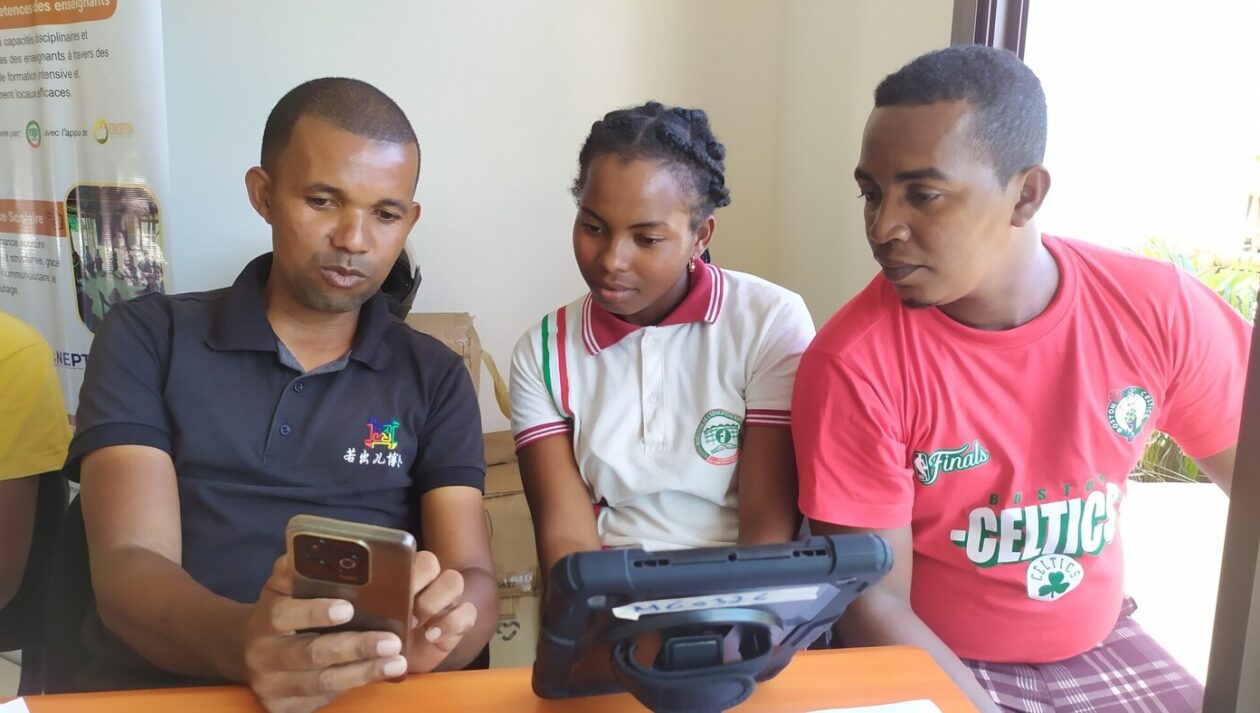
When teachers have a full understanding of what they are teaching and how to effectively teach, their students perform better. In Madagascar, teachers need support to strengthen their pedagogical skills and develop their content knowledge. Eighty percent of primary school teachers are not certified, and just 4% of all teachers have the essential content knowledge needed to teach foundational skills.
These factors contribute to low school completion rates and poor learning outcomes. Only about 63% of Malagasy girls and 58% of boys complete primary school, and most 10-year-olds can’t read and understand an age-appropriate text.
FHI 360, through the FIANTSO project — funded by the Hempel Foundation and operating in the southeastern Atsimo-Atsinanana region — is offering math and Malagasy language training and ongoing teacher professional development. To support the training, FHI 360 developed an AI-powered pedagogical chatbot. This tool was created through a collaborative, internally funded initiative, bringing together FHI 360 staff with varied expertise — including education, digital development, and monitoring, evaluation and learning — in close coordination with staff in Madagascar.
FHI 360 designed the chatbot to address a challenge faced by the champion teachers, zone leaders, school principals and pedagogical advisors who are heading the FIANTSO professional development program. Many pedagogical resources exist, but they are in different books and PDFs, not synthesized in one place. It’s difficult to quickly translate this content into easy-to-use advice.
“We thought, could AI support the work that FIANTSO is doing to strengthen teacher training skills by making this information more accessible and actionable?” says FHI 360 Senior Research Associate Rafael Contreras Gomez, who acted as product manager for the chatbot.
Context-specific, tailored content to meet educators’ needs
FHI 360 developed the chatbot in fall 2025 using a proven methodology informed by prior experience and already applied in other projects. Over three weeks in January, FHI 360 piloted the chatbot with 16 teachers and instructional leaders. It is trained on a repository of Ministry of National Education-validated teacher training and coaching modules for Malagasy and math instruction. When users ask it questions, answers include the source documents, complementing the existing resources rather than replacing them.
Malagasy is often spoken and written using dialect variations. The chatbot can understand the spelling of dialect Malagasy, meaning it can respond to the questions and prompts that people have in the language that they commonly speak.
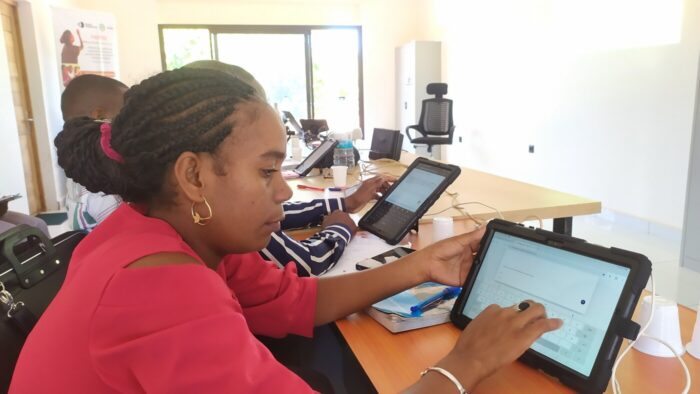
Participants used a WhatsApp group to share their experiences, receive support, and offer feedback to FHI 360. For example, some expressed interest in guidance specific to where they are in a lesson sequence, so FHI 360 will add that ability.
The pilot results were promising: 70% of users said the chatbot was very useful and 80% shared that it was easy or very easy to use. Two-thirds of participants used the chatbot two to three times a week, both in school and at home.
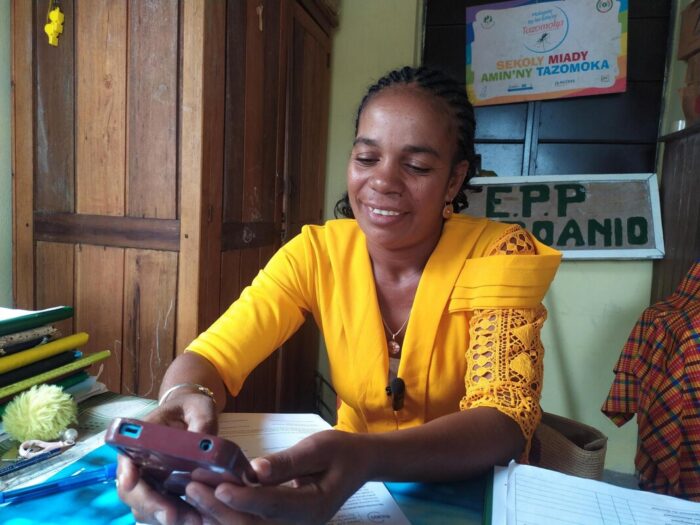
“This tool supports us during pedagogical learning sessions in teacher council and network meetings,” says Anneline Pierrette Razafileny, a school director in Farafangana. “It is practical and accessible due to how it allows me to ask questions and get answers directly in the Malagasy language.”
Building ethical AI products and teaching responsible usage
The chatbot’s professional development benefits are clear. It is also an introduction to AI for many participants. A key design decision was to incorporate guardrails: To avoid hallucinations, the chatbot only retrieves information from validated resources, and it only responds to pedagogy-related questions.
“Even in a context where digital literacy remains low and AI penetration remains even lower, the chatbot proved very intuitive for people to use,” says Rafael. “We’re bringing teachers in rural areas access to training on responsible uses of AI by giving them a resource they can use and trust.”

In the coming months, FHI 360 plans to refine the chatbot’s user interface and embed it into channels that teachers already use, like WhatsApp, to reflect user feedback and best practices for deploying digital products. Access is another consideration — how to ensure teachers can use the chatbot in a context where not everyone has a smartphone.
Once a fine-tuned version of the chatbot is ready, the team aims to test its effectiveness through a robust impact evaluation. If results indicate the chatbot’s potential to improve outcomes for teachers, instructional leaders, and critically, learners, the team will seek to scale the chatbot to more users over time.
What makes the chatbot special is that it’s not happening in isolation. “We’re not introducing it as a silver bullet,” says Rafael. “It’s part of a whole package of interventions in which the AI solution is enhancing something that has been going on for years, that is robust, that has the support of the government.”
All photos are credited to Todisoa Rasolonandrasana/FHI 360.